Online first
Bieżący numer
Archiwum
O czasopiśmie
Polityka etyki publikacyjnej
System antyplagiatowy
Instrukcje dla Autorów
Instrukcje dla Recenzentów
Rada Redakcyjna
Komitet Redakcyjny
Recenzenci
Wszyscy recenzenci
2025
2024
2023
2022
2021
2020
2019
2018
2017
2016
Kontakt
Bazy indeksacyjne
Klauzula przetwarzania danych osobowych (RODO)

PRACA ORYGINALNA
Analiza BMI i ocena wiedzy na temat zdrowego odżywiania oraz częstości spożycia wybranych produktów
pokarmowych w grupie kobiet zrzeszonych w Klubie Amazonki
1
Zakład Dietetyki, Akademia Łomżyńska, Polska
Zaznaczeni autorzy mieli równy wkład w przygotowanie tego artykułu
Autor do korespondencji
Marta Żebrowska-Gamdzyk
Zakład Dietetyki, Akademia Łomżyńska, ul. Akademicka 14, 18-400 Łomża, Polska
Zakład Dietetyki, Akademia Łomżyńska, ul. Akademicka 14, 18-400 Łomża, Polska
Med Og Nauk Zdr. 2026;32(2):155-160

SŁOWA KLUCZOWE
DZIEDZINY
STRESZCZENIE
Wprowadzenie i cel:
Rak piersi to najczęściej diagnozowany u kobiet nowotwór, a nadmierna masa ciała i nieprawidłowe odżywianie są jednymi z czynników ryzyka jego rozwoju. Celem pracy była analiza BMI w odniesieniu do oceny wiedzy na temat zdrowego żywienia i częstości spożywania wybranych grup produktów żywnościowych przez kobiety z rakiem piersi pozostającym w remisji.
Materiał i metody:
Do badania włączono 101 kobiet chorujących na raka piersi w remisji. Badanie miało charakter przekrojowy, jako narzędzie badawcze wykorzystano formularz autorskiej ankiety. W ankiecie zawarto pytania o wiek, wysokość i masę ciała, pytania sprawdzające wiedzę respondentek na temat zdrowego żywienia i pytania o konsumpcję wybranych grup produktów spożywczych. Parametry antropometryczne mierzono przy użyciu wagi podłogowej i wzrostomierza. Wyliczone wartości BMI interpretowano zgodnie z wytycznymi WHO
Wyniki:
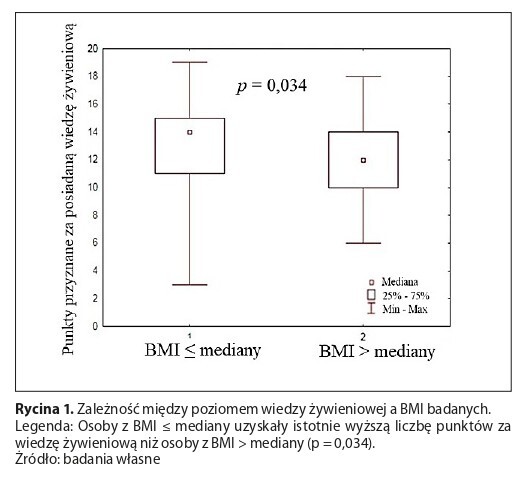
Nadwagę stwierdzono u 37,6% badanych, otyłość u 33,7%. Poziom wiedzy na temat zdrowego żywienia oceniono jako dobry w przypadku 61,4% respondentek. Zaobserwowano istotną zależność pomiędzy poziomem wiedzy badanych o zdrowym żywieniu a wartością ich BMI. Kobiety o BMI niższym/ równym medianie posiadały istotnie wyższą wiedzę w zakresie zdrowego żywienia niż kobiety o BMI powyżej mediany (mediana punktów wiedzy: 13 vs 10; p = 0,0408). Codzienne spożywanie warzyw deklarowało 82% kobiet, owoców – 79%. Spożywanie mięsa co najmniej raz w tygodniu wskazało 95% badanych, ryb – 77%, orzechów – 52%, zielonej herbaty – 50%, produktów smażonych/grillowanych/wędzonych – 34%, 78% badanych deklarowało, że nie spożywa produktów sojowych.
Wnioski:
W analizowanej populacji kobiet istotnym problemem jest nadmierna masa ciała. Badane kobiety posiadają dobrą wiedzę ogólną na temat prawidłowego żywienia. Zaobserwowane zachowania żywieniowe kobiet, u których rak piersi pozostaje w remisji, wymagają dalszych badań z wykorzystaniem standaryzowanych narzędzi badawczych.
Rak piersi to najczęściej diagnozowany u kobiet nowotwór, a nadmierna masa ciała i nieprawidłowe odżywianie są jednymi z czynników ryzyka jego rozwoju. Celem pracy była analiza BMI w odniesieniu do oceny wiedzy na temat zdrowego żywienia i częstości spożywania wybranych grup produktów żywnościowych przez kobiety z rakiem piersi pozostającym w remisji.
Materiał i metody:
Do badania włączono 101 kobiet chorujących na raka piersi w remisji. Badanie miało charakter przekrojowy, jako narzędzie badawcze wykorzystano formularz autorskiej ankiety. W ankiecie zawarto pytania o wiek, wysokość i masę ciała, pytania sprawdzające wiedzę respondentek na temat zdrowego żywienia i pytania o konsumpcję wybranych grup produktów spożywczych. Parametry antropometryczne mierzono przy użyciu wagi podłogowej i wzrostomierza. Wyliczone wartości BMI interpretowano zgodnie z wytycznymi WHO
Wyniki:
Nadwagę stwierdzono u 37,6% badanych, otyłość u 33,7%. Poziom wiedzy na temat zdrowego żywienia oceniono jako dobry w przypadku 61,4% respondentek. Zaobserwowano istotną zależność pomiędzy poziomem wiedzy badanych o zdrowym żywieniu a wartością ich BMI. Kobiety o BMI niższym/ równym medianie posiadały istotnie wyższą wiedzę w zakresie zdrowego żywienia niż kobiety o BMI powyżej mediany (mediana punktów wiedzy: 13 vs 10; p = 0,0408). Codzienne spożywanie warzyw deklarowało 82% kobiet, owoców – 79%. Spożywanie mięsa co najmniej raz w tygodniu wskazało 95% badanych, ryb – 77%, orzechów – 52%, zielonej herbaty – 50%, produktów smażonych/grillowanych/wędzonych – 34%, 78% badanych deklarowało, że nie spożywa produktów sojowych.
Wnioski:
W analizowanej populacji kobiet istotnym problemem jest nadmierna masa ciała. Badane kobiety posiadają dobrą wiedzę ogólną na temat prawidłowego żywienia. Zaobserwowane zachowania żywieniowe kobiet, u których rak piersi pozostaje w remisji, wymagają dalszych badań z wykorzystaniem standaryzowanych narzędzi badawczych.
Introduction and objective:
Breast cancer is the most common cancer diagnosed in women, and inadequate nutrition is among the risk factors for its development. The aim of this study is to analyze BMI in relation to the assessment of knowledge about healthy eating and the frequency of consumption of selected groups of food products among women in remission from breast cancer.
Material and methods:
The study enrolled 101 women in remission from breast cancer. The study was cross-sectional in nature, and was conducted using an author-constructed questionnaire. The questionnaire included questions concerning age, height, and weight, as well as questions assessing respondents’ knowledge of healthy eating and consumption of selected groups of food products. BMI values were interpreted according to the WHO guidelines
Results:
Overweight was diagnosed in 37.6% of the respondents, and obesity in 33.7%. The level of knowledge about healthy eating was assessed as good in the case of 61.4% of respondents. A significant correlation was observed between the level of knowledge about healthy eating and the respondents’ BMI. Women with BMI lower/equal to the median had significantly higher knowledge of healthy eating than those with BMI above the median (the median of knowledge points: 13 vs. 10; p = 0.0408). Daily vegetable consumption was reported by 82% of the women, and fruit consumption by 79%. Meat consumption at least once a week was reported by 95% of the respondents, fish consumption by 77%, nuts consumption by 52%, green tea consumption by 50%, fried/grilled/smoked foods consumption by 34%, and 78% of the respondents declared they did not consume soy products
Conclusions:
Excess body weight is an important problem in the analyzed female population. The women in the study possess good general knowledge of proper nutrition. The dietary patterns observed among women in remission from breast cancer require further studies using standardized research tools.
Breast cancer is the most common cancer diagnosed in women, and inadequate nutrition is among the risk factors for its development. The aim of this study is to analyze BMI in relation to the assessment of knowledge about healthy eating and the frequency of consumption of selected groups of food products among women in remission from breast cancer.
Material and methods:
The study enrolled 101 women in remission from breast cancer. The study was cross-sectional in nature, and was conducted using an author-constructed questionnaire. The questionnaire included questions concerning age, height, and weight, as well as questions assessing respondents’ knowledge of healthy eating and consumption of selected groups of food products. BMI values were interpreted according to the WHO guidelines
Results:
Overweight was diagnosed in 37.6% of the respondents, and obesity in 33.7%. The level of knowledge about healthy eating was assessed as good in the case of 61.4% of respondents. A significant correlation was observed between the level of knowledge about healthy eating and the respondents’ BMI. Women with BMI lower/equal to the median had significantly higher knowledge of healthy eating than those with BMI above the median (the median of knowledge points: 13 vs. 10; p = 0.0408). Daily vegetable consumption was reported by 82% of the women, and fruit consumption by 79%. Meat consumption at least once a week was reported by 95% of the respondents, fish consumption by 77%, nuts consumption by 52%, green tea consumption by 50%, fried/grilled/smoked foods consumption by 34%, and 78% of the respondents declared they did not consume soy products
Conclusions:
Excess body weight is an important problem in the analyzed female population. The women in the study possess good general knowledge of proper nutrition. The dietary patterns observed among women in remission from breast cancer require further studies using standardized research tools.
Żebrowska-Gamdzyk M, Pawelczyk M. Analiza BMI i ocena wiedzy w zakresie zdrowego odżywiania oraz częstości spożycia wybranych
produktów pokarmowych w grupie kobiet zrzeszonych w Klubie Amazonki. Med Og Nauk Zdr. 2026;32(2):155–160. doi:10.26444/monz/224260
REFERENCJE (25)
1.
Clinton SK, Giovannucci EL, Hursting SD. The World Cancer Research Fund/American Institute for Cancer Research third expert report on diet, nutrition, physical activity, and cancer: impact and future directions. J Nutr. 2020;150(4):663–671.
2.
Poorolajal J, Heidarimoghis F, Karami M, et al. Factors for the primary prevention of breast cancer: a meta-analysis of prospective cohort studies. J Res Health Sci. 2021. https://doi.org/10.34172/jrhs.....
3.
Li Y, Li S, Meng X, et al. Dietary natural products for prevention and treatment of breast cancer. Nutrients. 2017; https://doi.org/10.3390/nu9070....
4.
Malczyk E, Majkrzak Ż. Nutritional risk factors for developing breast cancer. Probl Hig Epidemiol. 2015;96(1):67–76.
5.
Yu S, Zhu L, Wang K, et al. Grean tee consumption and risk of breast cancer. Medicine (Baltimore). 2019. https://doi.org/10.1097/MD.000....
6.
Zheng J, Hu X, Zhao Y, et al. Intake of fish and marine n-3 polyunsaturated fatty acids and risk of breast cancer: meta-analysis of data from 21 independent prospective cohort studies. BMJ. 2013. https://doi.org/10.1136/bmj.f3....
7.
Wang C, Gu K, Wang F, et al. Nut consumption in association with overall mortality and recurrence/disease specific mortality among long-term breast cancer survivors. Int J Cancer. 2022;150(4):572–579.
8.
Malczyk E, Kapera M. The assessment of knowledge and eating habits of adults in terms of cancer incidence. Piel Zdr Publ. 2019;9(2):97–106.
9.
Wądołowska L, Krusińska B. Procedura opracowania danych żywieniowych z kwestionariusza KomPAN. In: Gawęcki J, editor. KomPAN kwestionariusz do badania poglądów i zwyczajów żywieniowych oraz procedura opracowania danych. Olsztyn: Wyd. Komitetu Nauki o Żywieniu Człowieka Polskiej Akademii Nauk; 2024. p. 43.
10.
Engin A. Obesity-associated breast cancer: analysis of risk factors and current clinical evaluation. Adv Exp Med Biol. 2024;1460:767–819.
11.
Niraula S, Ocana A, Ennis M, et al. Body size and breast cancer prognosis in relation to hormone receptor and menopausal status: a meta-analysis. Breast Cancer Res Treat. 2012;134(2):769–781.
12.
Yang H, Liu L, Zhang X. Exercise interventions on body composition and quality of life of overweight/obese breast cancer survivors: a meta-analysis. BMC Women›s Health. 2023;23(1):484. https://doi.org/10.1186/s12905....
13.
Kałędkiewicz E, Szostak-Węgierek D. Dietary practices and nutritional status in survivors of breast cancer. Rocz Panstw Zakl Hig. 2018;69(2):175–182.
14.
O’Brien G, Davies M. Nutrition knowledge and body mass index. Health Educ Res. 2007;22(4):571–575.
15.
Parekh N, Jiang J, Buchan M, et al. Nutrition literacy among cancer survivors: feasibility results from the healthy eating and living against breast cancer (HEAL-BCa) Study: a pilot randomized controlled trial. J Cancer Educ. 2018;33(6):1239–1249.
16.
Andersen JLM, Hansen L, Thomsen BLR, et al. Pre-and post-diagnostic intake of whole grain and dairy products and breast cancer prognosis: the Danish Diet, Cancer and Health cohort. Breast Cancer Res Treat. 2020;179(3):743–753.
17.
Cong M, Wang J, Fang Y, et al. A multi-center survey on dietary knowledge and behavior among inpatients in oncology department. Support Care Cancer. 2018;26:2285–2292.
18.
Demuth A, Czerniak U. Eating habits and preferences of Polish women undergoing treatment for breast cancer. Asian Pac J Cancer Prev. 2019;20(6):1803–1808.
19.
Inoue-Choi M, Sinha R, Gierach GL, et al. Red and processed meat, nitrite and heme iron intakes and postmenopausal breast cancer risk in the NIH-AARP Diet and Health Study. Int J Cancer. 2016;138:1609–1618.
20.
Lo JJ, Park YM, Sinha R, et al. Association between meat consumption and risk of breast cancer. Findings from The Sister Study. Int J Cancer. 2020;146:2156–2165.
21.
Marchio V, Augimeri G, Morelli C, et al. Omega-3 fatty acids: molecular weapons against chemoresistance in breast cancer. Cell Mol Biol Lett. 2025. https://doi.org/10.1186/s11658....
22.
Sharif Y, Sadeghi O, Banisi-Kohansal S, et al. Legume and nuts consumption in relation to Odds of breast cancer: a case-control study. Nutr Cancer. 2021;73(5):750–759.
23.
Liu S, Ou S, Huang H. Green tea polyphenols induce cell death in breast cancer MCF-7 cell through induction of cell cycle arrest and mitochondrial-mediated apoptosis. J Zhejiang Univ Sci B. 2017;18(2):89–98.
24.
Stordal B, Harvie M, Antoniou MN, et al. Breast cancer risk and prevention in 2024: An overview from the Breast Cancer UK – Breast Cancer Prevention Conference. Cancer Med. 2024. https://doi.org/10.1002/cam4.7....
25.
Wei Y, Lv J, Guo Y, et al. Soy intake and breast cancer risk: a prospective study of 300,000 Chinese women and a dose-response meta-analysis. Eur J Epidemiol. 2019;35(6):567–578.
Udostępnij
ARTYKUŁ POWIĄZANY
| eISSN: | 2084-4905 |
| ISSN: | 2083-4543 |

Przetwarzamy dane osobowe zbierane podczas odwiedzania serwisu. Realizacja funkcji pozyskiwania informacji o użytkownikach i ich zachowaniu odbywa się poprzez dobrowolnie wprowadzone w formularzach informacje oraz zapisywanie w urządzeniach końcowych plików cookies (tzw. ciasteczka). Dane, w tym pliki cookies, wykorzystywane są w celu realizacji usług, zapewnienia wygodnego korzystania ze strony oraz w celu monitorowania ruchu zgodnie z Polityką prywatności. Dane są także zbierane i przetwarzane przez narzędzie Google Analytics (więcej).
Możesz zmienić ustawienia cookies w swojej przeglądarce. Ograniczenie stosowania plików cookies w konfiguracji przeglądarki może wpłynąć na niektóre funkcjonalności dostępne na stronie.
Możesz zmienić ustawienia cookies w swojej przeglądarce. Ograniczenie stosowania plików cookies w konfiguracji przeglądarki może wpłynąć na niektóre funkcjonalności dostępne na stronie.