Online first
Bieżący numer
Archiwum
O czasopiśmie
Polityka etyki publikacyjnej
System antyplagiatowy
Instrukcje dla Autorów
Instrukcje dla Recenzentów
Rada Redakcyjna
Komitet Redakcyjny
Recenzenci
Wszyscy recenzenci
2025
2024
2023
2022
2021
2020
2019
2018
2017
2016
Kontakt
Bazy indeksacyjne
Klauzula przetwarzania danych osobowych (RODO)

PRACA ORYGINALNA
Występowanie wad stóp u dzieci w wieku 7 lat w zależności od poziomu aktywności fizycznej
1
Instytut Nauk o Zdrowiu, Katedra Rehabilitacji i Odnowy Biologicznej, Uniwersytet Pomorski, Słupsk, Polska
2
Klinika Anestezjologii i Intensywnej Terapii, Uniwersyteckie Centrum Kliniczne, Słupsk, Polska
Autor do korespondencji
Jakub Pawłowski
Instytut Nauk o Zdrowiu, Katedra Rehabilitacji i Odnowy Biologicznej, Uniwersytet Pomorski w Słupsku, ul. Arci- szewskiego 22a, 76-200 Słupsk
Instytut Nauk o Zdrowiu, Katedra Rehabilitacji i Odnowy Biologicznej, Uniwersytet Pomorski w Słupsku, ul. Arci- szewskiego 22a, 76-200 Słupsk
Med Og Nauk Zdr. 2026;32(3):233-236

SŁOWA KLUCZOWE
DZIEDZINY
STRESZCZENIE
Wprowadzenie i cel:
Prawidłowe wysklepienie stóp odgrywa istotną rolę w rozwoju narządu ruchu dziecka. Okres wczesnoszkolny jest kluczowy dla kształtowania łuku podłużnego stopy, a jednocześnie charakteryzuje się wysoką częstością występowania jego nieprawidłowości. Celem pracy była ocena częstości występowania wad stóp u dzieci w wieku 7 lat oraz analiza zależności pomiędzy wysklepieniem stóp, parametrami antropometrycznymi i poziomem pozalekcyjnej aktywności fizycznej.
Materiał i metody:
Badaniem przekrojowym objęto 110 dzieci w wieku 7 lat. Wykonano pomiary masy ciała, wzrostu i BMI oraz oceniono poziom pozalekcyjnej aktywności fizycznej. Wysklepienie stóp oceniono metodą podoskopową z wykorzystaniem kąta Clarke’a. Na podstawie uzyskanych wartości stopy klasyfikowano jako prawidłowe, z obniżonym wysklepieniem, płaskie lub wydrążone. Do analizy statystycznej zastosowano test U Manna-Whitneya.
Wyniki:
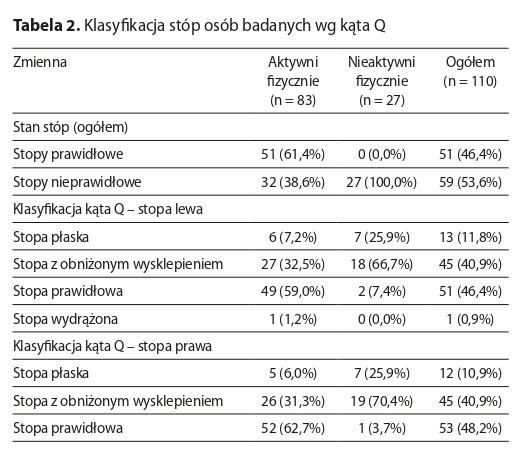
Wady stóp stwierdzono u 53,6% badanych dzieci, przy czym najczęściej występowało obniżone wysklepienie łuku podłużnego. Dzieci aktywne fizycznie charakteryzowały się istotnie wyższymi wartościami kąta Clarke’a dla obu stóp w porównaniu z dziećmi nieaktywnymi (p < 0,000). Średni kąt Clarke’a był o 12,93° większy w grupie dzieci aktywnych. Nie wykazano istotnych różnic między grupami w zakresie masy ciała, wzrostu i BMI.
Wnioski:
Wady stóp są częstym problemem u dzieci w wieku wczesnoszkolnym. Pozalekcyjna aktywność fizyczna wiąże się z korzystniejszym wysklepieniem stóp i może stanowić istotny element profilaktyki zaburzeń morfologii stóp u dzieci.
Prawidłowe wysklepienie stóp odgrywa istotną rolę w rozwoju narządu ruchu dziecka. Okres wczesnoszkolny jest kluczowy dla kształtowania łuku podłużnego stopy, a jednocześnie charakteryzuje się wysoką częstością występowania jego nieprawidłowości. Celem pracy była ocena częstości występowania wad stóp u dzieci w wieku 7 lat oraz analiza zależności pomiędzy wysklepieniem stóp, parametrami antropometrycznymi i poziomem pozalekcyjnej aktywności fizycznej.
Materiał i metody:
Badaniem przekrojowym objęto 110 dzieci w wieku 7 lat. Wykonano pomiary masy ciała, wzrostu i BMI oraz oceniono poziom pozalekcyjnej aktywności fizycznej. Wysklepienie stóp oceniono metodą podoskopową z wykorzystaniem kąta Clarke’a. Na podstawie uzyskanych wartości stopy klasyfikowano jako prawidłowe, z obniżonym wysklepieniem, płaskie lub wydrążone. Do analizy statystycznej zastosowano test U Manna-Whitneya.
Wyniki:
Wady stóp stwierdzono u 53,6% badanych dzieci, przy czym najczęściej występowało obniżone wysklepienie łuku podłużnego. Dzieci aktywne fizycznie charakteryzowały się istotnie wyższymi wartościami kąta Clarke’a dla obu stóp w porównaniu z dziećmi nieaktywnymi (p < 0,000). Średni kąt Clarke’a był o 12,93° większy w grupie dzieci aktywnych. Nie wykazano istotnych różnic między grupami w zakresie masy ciała, wzrostu i BMI.
Wnioski:
Wady stóp są częstym problemem u dzieci w wieku wczesnoszkolnym. Pozalekcyjna aktywność fizyczna wiąże się z korzystniejszym wysklepieniem stóp i może stanowić istotny element profilaktyki zaburzeń morfologii stóp u dzieci.
Introduction and objective:
Correct arching of the feet plays an important role in the development of the musculoskeletal system in children. Early school age is a critical period for the formation of the longitudinal arch of the foot and is simultaneously associated with a high prevalence of its abnormalities. The aim of this study is to assess the prevalence of foot deformities in 7-year-old children and to analyze the relationship between foot arch structure, anthropometric parameters, and the level of extracurricular physical activity.
Material and methods:
This cross-sectional study included 110 children aged 7 years. Measurements of body weight, height, and BMI were performed, and the level of extracurricular physical activity was assessed. Foot arch morphology was evaluated using a podoscopic examination with calculation of the Clarke’s angle. Based on the obtained values, feet were classified as normal, with lowered arch, flatfoot, or cavus foot. Statistical analysis was conducted using the Mann–Whitney U test.
Results:
Foot deformities were identified in 53.6% of the examined children, with lowered longitudinal arch being the most common abnormality. Physically active children demonstrated significantly higher Clarke’s angle values for both feet, compared to physically inactive children (p < 0.000). The mean Clarke’s angle was higher by 12.93° in the physically active group. No significant differences were found between the groups in terms of body weight, height, or BMI
Conclusions:
Foot deformities are a common problem among early school-age children. Extracurricular physical activity is associated with more favourable foot arch morphology, and may constitute an important element in the prevention of foot structure disorders in children.
Correct arching of the feet plays an important role in the development of the musculoskeletal system in children. Early school age is a critical period for the formation of the longitudinal arch of the foot and is simultaneously associated with a high prevalence of its abnormalities. The aim of this study is to assess the prevalence of foot deformities in 7-year-old children and to analyze the relationship between foot arch structure, anthropometric parameters, and the level of extracurricular physical activity.
Material and methods:
This cross-sectional study included 110 children aged 7 years. Measurements of body weight, height, and BMI were performed, and the level of extracurricular physical activity was assessed. Foot arch morphology was evaluated using a podoscopic examination with calculation of the Clarke’s angle. Based on the obtained values, feet were classified as normal, with lowered arch, flatfoot, or cavus foot. Statistical analysis was conducted using the Mann–Whitney U test.
Results:
Foot deformities were identified in 53.6% of the examined children, with lowered longitudinal arch being the most common abnormality. Physically active children demonstrated significantly higher Clarke’s angle values for both feet, compared to physically inactive children (p < 0.000). The mean Clarke’s angle was higher by 12.93° in the physically active group. No significant differences were found between the groups in terms of body weight, height, or BMI
Conclusions:
Foot deformities are a common problem among early school-age children. Extracurricular physical activity is associated with more favourable foot arch morphology, and may constitute an important element in the prevention of foot structure disorders in children.
INFORMACJE O RECENZOWANIU
Sprawdzono w systemie antyplagiatowym
Pawłowski J, Brzozowski M. Występowanie wad stóp u dzieci w wieku 7 lat w zależności od poziomu aktywności fizycznej. Med Og Nauk Zdr. 2026;32(3):233–236. doi:10.26444/monz/224509
REFERENCJE (10)
1.
Sadeghi-Demneh E, Jafarian F, Melvin JMA, Azadinia F, Shamsi F, Jafarpishe M. Flatfoot in School-Age Children. Foot Ankle Spec. 2015;8:186–93. https://doi.org/10.1177/193864....
2.
Kardm SM, Alanazi ZA, Aldugman TAS, Reddy RS, Gautam AP. Prevalence and functional impact of flexible flatfoot in school-aged children: a cross-sectional clinical and postural assessment. J Orthop Surg Res. 2025;20:783. https://doi.org/10.1186/s13018....
3.
Jandova S. Flat feet occurrence among young school-age children and its association with body mass index values. HOMO. 2024;75:1–7. https://doi.org/10.1127/homo/2....
4.
Szczepanowska-Wolowiec B, Sztandera P, Kotela I, Zak M. Vulnerability of the foot’s morphological structure to deformities caused by foot loading paradigm in school-aged children: a cross-sectional study. Sci Rep. 2021;11:2749. https://doi.org/10.1038/s41598....
5.
Büyükçelebi H, Açak M, Eken Ö, Doğaner A, Özen G, Ardigò LP. Association between pediatric obesity and foot morphology: insights from a large-scale cross-sectional study using photogrammetry. BMC Pediatr. 2025;25:628. https://doi.org/10.1186/s12887....
6.
Molina-García C, Álvarez-Salvago F, Pujol-Fuentes C, López-del-Amo-Lorente A, Ramos-Petersen L, Martínez-Sebastián C, et al. Descriptive Study of the Influence of Foot Type on Physical Characteristics, Laxity, Strength and Baropodometry in Children Aged 5 to 10 Years. Applied Sciences. 2024;14:8578. https://doi.org/10.3390/app141....
7.
Luk S-H, Li P-L, Yick K-L, Liu Q-L, Ho C-P, Yip J. Two-Dimensional Footprint-Based Estimation of Arch Height of Chinese Children with Flatfeet. Applied Sciences. 2025;15:11737. https://doi.org/10.3390/app152....
8.
Nurhidayah RD, Naufal AF. Measurement Accuracy of Foot Arcus in Children Aged 8–12 years: Mobile Application vs Goniometer. Jurnal Kesehatan. 2025;16:363–9. https://doi.org/10.26630/jk.v1....
9.
Szczepanowska-Wołowiec B, Sztandera P, Kotela I, Żak M. The foot’s key structural variables as essential diagnostic predictors in assessing overall postural stability in school-aged children: a cross-sectional study. Medical Studies. 2022;38:321–9. https://doi.org/10.5114/ms.202....
10.
Sadeghi-Demneh E, Jafarian F, Melvin JMA, Azadinia F, Shamsi F, Jafarpishe M. Flatfoot in School-Age Children. Foot Ankle Spec. 2015;8:186–94. https://doi.org/10.1177/193864....
Udostępnij
ARTYKUŁ POWIĄZANY
| eISSN: | 2084-4905 |
| ISSN: | 2083-4543 |

Przetwarzamy dane osobowe zbierane podczas odwiedzania serwisu. Realizacja funkcji pozyskiwania informacji o użytkownikach i ich zachowaniu odbywa się poprzez dobrowolnie wprowadzone w formularzach informacje oraz zapisywanie w urządzeniach końcowych plików cookies (tzw. ciasteczka). Dane, w tym pliki cookies, wykorzystywane są w celu realizacji usług, zapewnienia wygodnego korzystania ze strony oraz w celu monitorowania ruchu zgodnie z Polityką prywatności. Dane są także zbierane i przetwarzane przez narzędzie Google Analytics (więcej).
Możesz zmienić ustawienia cookies w swojej przeglądarce. Ograniczenie stosowania plików cookies w konfiguracji przeglądarki może wpłynąć na niektóre funkcjonalności dostępne na stronie.
Możesz zmienić ustawienia cookies w swojej przeglądarce. Ograniczenie stosowania plików cookies w konfiguracji przeglądarki może wpłynąć na niektóre funkcjonalności dostępne na stronie.