RESEARCH PAPER
Modern approaches to self-care in type 2 diabetes: from knowledge to everyday practice. Pilot study
1
Faculty of Health Sciences, Wroclaw Medical University, Polska
2
Faculty of Health Sciences, Department of Public Health, Wroclaw Medical University, Polska
Corresponding author
Angelika Kierczak
Wydział Nauk o Zdrowiu, Uniwersytet Medyczny Wrocław im. Piastów Śląskich we Wrocławiu, ul. T. Chałubińskiego 3, 50-367 Wrocław, Polska
Wydział Nauk o Zdrowiu, Uniwersytet Medyczny Wrocław im. Piastów Śląskich we Wrocławiu, ul. T. Chałubińskiego 3, 50-367 Wrocław, Polska
Med Og Nauk Zdr. 2026;32(2):161-166

KEYWORDS
TOPICS
ABSTRACT
Introduction and objective:
Type 2 diabetes is a growing global pandemic of the 21st century, affecting approximately 3 million people in Poland. Treatment requires an active involvement of the patient in the therapeutic process. Selfcare, including glycaemic control, diet, and physical activity, is crucial for improvement of the quality of life and reduction of complications. The aim of the study is to assess the level of self-care and identify problems of patients with type 2 diabetes using the SCODI questionnaire.
Material and methods:
The study covered 120 patients, including 70% of females and 30% of males, with the largest group aged over 65 (25%), and was carried out using the SCODI questionnaire (40 items in 4 domains). The study was conducted online and an access was provided via a QR code to patients of the Non-Public Healthcare Centre in Świdnica.
Results:
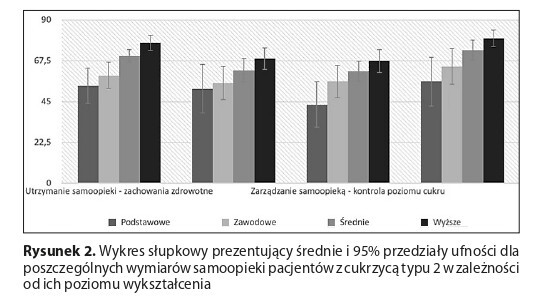
The mean overall self-care score was 76/100, indicating an average level. Respondents performed best in maintaining healthy habits, while the worst in monitoring their health and controlling glucose levels. A strong positive correlation was found between self-confidence in disease management and other dimensions of self-care (p 3 years). Higher and secondary education were associated with better outcomes (p<0.001), suggesting a link with health awareness.
Conclusions:
Patients with type 2 diabetes require ongoing educational support. Males, patients with lower levels of education, and those who have had the disease for a long time and have shown a decline in motivation require particular attention. It is essential to tailor educational programmes to the specific needs of these groups.
Type 2 diabetes is a growing global pandemic of the 21st century, affecting approximately 3 million people in Poland. Treatment requires an active involvement of the patient in the therapeutic process. Selfcare, including glycaemic control, diet, and physical activity, is crucial for improvement of the quality of life and reduction of complications. The aim of the study is to assess the level of self-care and identify problems of patients with type 2 diabetes using the SCODI questionnaire.
Material and methods:
The study covered 120 patients, including 70% of females and 30% of males, with the largest group aged over 65 (25%), and was carried out using the SCODI questionnaire (40 items in 4 domains). The study was conducted online and an access was provided via a QR code to patients of the Non-Public Healthcare Centre in Świdnica.
Results:
The mean overall self-care score was 76/100, indicating an average level. Respondents performed best in maintaining healthy habits, while the worst in monitoring their health and controlling glucose levels. A strong positive correlation was found between self-confidence in disease management and other dimensions of self-care (p 3 years). Higher and secondary education were associated with better outcomes (p<0.001), suggesting a link with health awareness.
Conclusions:
Patients with type 2 diabetes require ongoing educational support. Males, patients with lower levels of education, and those who have had the disease for a long time and have shown a decline in motivation require particular attention. It is essential to tailor educational programmes to the specific needs of these groups.
REFERENCES (11)
1.
International Diabetes Federation. IDF Diabetes Atlas. 10th ed. Brussels: International Diabetes Federation; 2021. https://diabetesatlas.org (access: 2025.12.06).
2.
Termedia. Prawie 8 mln Polaków ma cukrzycę lub stan przedcukrzycowy. https://www.termedia.pl/diabet... (access: 2025.12.04).
3.
Polskie Stowarzyszenie Diabetyków. Samokontrola a samoopieka w cukrzycy. https://diabetyk.org.pl/samoko... (access: 2025.12.04).
4.
Chrobak-Bień J, Gawor A, Borowiak E. Analysis of factors influencing the quality of life of people with type 2 diabetes. Pielęgniarstwo w Opiece Długoterminowej. 2024;9(3):13–28. https://doi.org/10.19251/pwod/...).
5.
Shrivastava SR, Shrivastava PS, Ramasamy J. Role of self-care in management of diabetes mellitus. J Diabetes Metab Disord. 2013;12(1):14. https://doi.org/10.1186/2251-6....
6.
Majkowska L. Definicja i klasyfikacja cukrzycy. In: Majkowska L, editor. Podstawy diabetologii: dla studentów medycyny i lekarzy praktyków. Szczecin: Wydawnictwo Pomorskiego Uniwersytetu Medycznego; 2016. p. 7–17. https://doi.org/10.48745/ppm.4....
7.
Uchmanowicz I, Krzemińska S, Ausili D, Luciani M, Lisiak M. Polish Adaptation of the Self-Care of Diabetes Inventory (SCODI). Patient Prefer Adherence. 2020;14:1341–1350.
8.
World Health Organization. Self-care for health and well-being. https://www.who.int/news-room/... (access: 2025.12.04).
9.
Ausili D, Rossi E, Rebora P, Luciani M, Tonoli L, Ballerini E, Androni S, Vellone E, Riegel B, Di Mauro S. Socio-demographic and clinical determinants of self-care in adults with type 2 diabetes: a multicentre observation study. Acta Diabetol. 2018;55(7):691–702. https://doi.org/10.1007/s00592....
10.
Krzemińska S, Czapor E. Ocena poziomu samoopieki u pacjentów z cukrzycą typu 2 z zastosowaniem kwestionariusza Self-care of Diabetes Inventory (SCODI). Współczesne Pielęgniarstwo i Ochrona Zdrowia. 2019;8:4.
11.
Bąk E, Potoczna R, Kupczak-Wiśniowska B. Involvement in self-care of patient with type 2 diabetes aged 60–80. J Educ Health Sport. 2024;64:34–50.
Share
RELATED ARTICLE
| eISSN: | 2084-4905 |
| ISSN: | 2083-4543 |

We process personal data collected when visiting the website. The function of obtaining information about users and their behavior is carried out by voluntarily entered information in forms and saving cookies in end devices. Data, including cookies, are used to provide services, improve the user experience and to analyze the traffic in accordance with the Privacy policy. Data are also collected and processed by Google Analytics tool (more).
You can change cookies settings in your browser. Restricted use of cookies in the browser configuration may affect some functionalities of the website.
You can change cookies settings in your browser. Restricted use of cookies in the browser configuration may affect some functionalities of the website.