Online first
Bieżący numer
Archiwum
O czasopiśmie
Polityka etyki publikacyjnej
System antyplagiatowy
Instrukcje dla Autorów
Instrukcje dla Recenzentów
Rada Redakcyjna
Komitet Redakcyjny
Recenzenci
Wszyscy recenzenci
2025
2024
2023
2022
2021
2020
2019
2018
2017
2016
Kontakt
Bazy indeksacyjne
Klauzula przetwarzania danych osobowych (RODO)
PRACA ORYGINALNA
Ocena ryzyka zdrowotnego związanego z obecnością kadmu i ołowiu w warzywach korzeniowych pochodzących z handlu detalicznego i upraw prywatnych zlokalizowanych na terenie województwa śląskiego w Polsce
1
Department of Environmental Health, Division of Environmental Health, Faculty of Public Health in Bytom, Medical University of Silesia, Katowice, Poland
Autor do korespondencji
Weronika Osmala-Kurpiewska
Department of Environmental Health, Division of Environmental Health, Faculty of Public Health in Bytom, Medical University of Silesia in Katowice, Piekarska 18, 41-902 Bytom, Poland
Department of Environmental Health, Division of Environmental Health, Faculty of Public Health in Bytom, Medical University of Silesia in Katowice, Piekarska 18, 41-902 Bytom, Poland
Med Og Nauk Zdr. 2026;32(3):220-226

SŁOWA KLUCZOWE
DZIEDZINY
STRESZCZENIE
Wprowadzenie i cel:
Warzywa korzeniowe są niezbędnym elementem zdrowej diety, ale mogą gromadzić metale ciężkie, takie jak kadm (Cd) i ołów (Pb). Województwo śląskie jest jednym z najbardziej zanieczyszczonych regionów w Polsce. W związku z tym pojawiły się obawy dotyczące bezpieczeństwa lokalnie produkowanej żywności ze względu na podwyższone stężenie metali ciężkich w glebach regionu. Celem badania było określenie stężeń toksycznych metali ciężkich (Cd i Pb) w warzywach korzeniowych i ocena potencjalnych zagrożeń dla zdrowia związanych z ich spożywaniem.
Materiał i metody:
Badaniem objęto 114 próbek warzyw korzeniowych (w tym marchwi, korzeni pietruszki i ziemniaków) zebranych jesienią 2025 roku ze źródeł komercyjnych i prywatnych w województwie śląskim. Zawartość Cd i Pb w próbkach oznaczono za pomocą bezpłomieniowego elektrotermicznego spektrometru absorpcji atomowej (ET-AAS). Do analizy statystycznej wykorzystano testy nieparametryczne. Ocenę ryzyka dla zdrowia przeprowadzono z wykorzystaniem ilorazu zagrożenia (HQ) i marginesu narażenia (MoE).
Wyniki:
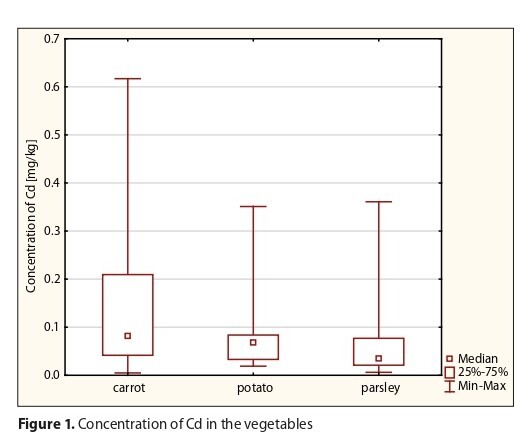
Dopuszczalne stężenie Cd zostało przekroczone w trzydziestu pięciu próbkach, a dopuszczalny poziom Pb w pięciu. Ocena narażenia wykazała, że wartości HQ dla Cd przekroczyły 1 w niektórych próbkach marchwi o wysokim stężeniu (Cd: 1,43). Niskie wartości MoE uzyskane dla Pb, szczególnie w Scenariuszu II, sugerują, że nie można całkowicie wykluczyć potencjalnych zagrożeń dla zdrowia wynikających z obecności kadmu i ołowiu w badanych warzywach.
Wnioski:
Wyniki badań wskazują na konieczność regularne go monitorowania zawartości metali ciężkich w warzywach, szczególnie w tych uprawianych w regionach uprzemysłowionych.
Warzywa korzeniowe są niezbędnym elementem zdrowej diety, ale mogą gromadzić metale ciężkie, takie jak kadm (Cd) i ołów (Pb). Województwo śląskie jest jednym z najbardziej zanieczyszczonych regionów w Polsce. W związku z tym pojawiły się obawy dotyczące bezpieczeństwa lokalnie produkowanej żywności ze względu na podwyższone stężenie metali ciężkich w glebach regionu. Celem badania było określenie stężeń toksycznych metali ciężkich (Cd i Pb) w warzywach korzeniowych i ocena potencjalnych zagrożeń dla zdrowia związanych z ich spożywaniem.
Materiał i metody:
Badaniem objęto 114 próbek warzyw korzeniowych (w tym marchwi, korzeni pietruszki i ziemniaków) zebranych jesienią 2025 roku ze źródeł komercyjnych i prywatnych w województwie śląskim. Zawartość Cd i Pb w próbkach oznaczono za pomocą bezpłomieniowego elektrotermicznego spektrometru absorpcji atomowej (ET-AAS). Do analizy statystycznej wykorzystano testy nieparametryczne. Ocenę ryzyka dla zdrowia przeprowadzono z wykorzystaniem ilorazu zagrożenia (HQ) i marginesu narażenia (MoE).
Wyniki:
Dopuszczalne stężenie Cd zostało przekroczone w trzydziestu pięciu próbkach, a dopuszczalny poziom Pb w pięciu. Ocena narażenia wykazała, że wartości HQ dla Cd przekroczyły 1 w niektórych próbkach marchwi o wysokim stężeniu (Cd: 1,43). Niskie wartości MoE uzyskane dla Pb, szczególnie w Scenariuszu II, sugerują, że nie można całkowicie wykluczyć potencjalnych zagrożeń dla zdrowia wynikających z obecności kadmu i ołowiu w badanych warzywach.
Wnioski:
Wyniki badań wskazują na konieczność regularne go monitorowania zawartości metali ciężkich w warzywach, szczególnie w tych uprawianych w regionach uprzemysłowionych.
Introduction and objective:
Root vegetables are an essential part of a healthy diet, but they can also accumulate heavy metals, such as cadmium (Cd) and lead (Pb). The Silesian Province is one of the most polluted areas in Poland; as a result, concerns have been raised about the safety of locally produced food due to elevated concentrations of heavy metals in the region›s soils. The aim of the study is to determine the concentrations of toxic heavy metals (Cd and Pb) in root vegetables and assess the potential health risks associated with their consumption.
Material and methods:
The study included 114 samples of root vegetables (including carrots, parsley roots and potatoes) harvested in autumn 2025 and collected from commercial and private sources in the Silesian Province in south-west Poland. The Cd and Pb content of the samples was determined using a flameless electrothermal atomic absorption spectrometer (ET-AAS). Non-parametric tests were used for statistical analysis. Health risk assessment was performed using the hazard quotient (HQ) and margin of exposure (MoE).
Results:
The permissible concentration of Cd was exceeded in 35 samples, while the permissible level of Pb was exceeded in samples. The exposure assessment indicated that HQ values for Cd exceeded 1 in some high-concentration carrot samples (Cd: 1.43). The low MoE values obtained for Pb, particularly under Scenario II, suggest that potential health concerns cannot be completely ruled out.
Conclusions:
The study results indicate the need for regular monitoring of heavy metal content in vegetables, especially in industrialized regions.
Root vegetables are an essential part of a healthy diet, but they can also accumulate heavy metals, such as cadmium (Cd) and lead (Pb). The Silesian Province is one of the most polluted areas in Poland; as a result, concerns have been raised about the safety of locally produced food due to elevated concentrations of heavy metals in the region›s soils. The aim of the study is to determine the concentrations of toxic heavy metals (Cd and Pb) in root vegetables and assess the potential health risks associated with their consumption.
Material and methods:
The study included 114 samples of root vegetables (including carrots, parsley roots and potatoes) harvested in autumn 2025 and collected from commercial and private sources in the Silesian Province in south-west Poland. The Cd and Pb content of the samples was determined using a flameless electrothermal atomic absorption spectrometer (ET-AAS). Non-parametric tests were used for statistical analysis. Health risk assessment was performed using the hazard quotient (HQ) and margin of exposure (MoE).
Results:
The permissible concentration of Cd was exceeded in 35 samples, while the permissible level of Pb was exceeded in samples. The exposure assessment indicated that HQ values for Cd exceeded 1 in some high-concentration carrot samples (Cd: 1.43). The low MoE values obtained for Pb, particularly under Scenario II, suggest that potential health concerns cannot be completely ruled out.
Conclusions:
The study results indicate the need for regular monitoring of heavy metal content in vegetables, especially in industrialized regions.
INFORMACJE O RECENZOWANIU
Sprawdzono w systemie antyplagiatowym
REFERENCJE (31)
1.
World Health Organization. Diet, nutrition and the prevention of chronic diseases. Geneva: World Health Organization; 2003. https://www.who.int/publicatio.... (accessed: 2026.03.20).
2.
Herforth A, Arimond M, Álvarez-Sánchez C, et al. A Global Review of Food-Based Dietary Guidelines. Adv Nutr. 2019;10(4):590–605. https://doi.org/10.1093/advanc....
3.
Kalmpourtzidou A, Eilander A, Talsma EF. Global Vegetable Intake and Supply Compared to Recommendations: A Systematic Review. Nutrients. 2020;12(6):1558. https://doi.org/10.3390/nu1206....
4.
Liang G, Gong W, Li B, et al. Analysis of Heavy Metals in Foodstuffs and an Assessment of the Health Risks to the General Public via Consumption in Beijing, China. Int J Environ Res Public Health. 2019;16(6):909. https://doi.org/10.3390/ijerph....
5.
Manwani S, Devi P, Singh T, et al. Heavy metals in vegetables: a review of status, human health concerns, and management options. Environ Sci Pollut Res Int. 2023;30(28):71940–71956. https://doi.org/10.1007/s11356....
6.
Zhang J, Li H, Zhou Y, et al. Bioavailability and soil-to-crop transfer of heavy metals in farmland soils: A case study in the Pearl River Delta, South China. Environ Pollut. 2018;235:710–719. https://doi.org/10.1016/j.envp....
7.
Cao L, Wu J. Feasibility analysis of waste humus soil for Urban Greening. IOP Conf. Ser. Earth Environ. Sci. 2020;546:032054. https://doi.org/10.1088/1755-1....
8.
Ren Q, Ru S, Zheng K, et al. Soil properties, heavy metal accumulation, and ecological risk in vegetable greenhouses of different planting years. Huan Jing Ke Xue. 2022;43(2):995–1003. https://doi.org/10.13227/j.hjk....
9.
Chen Z, Muhammad I, Zhang Y, et al. Transfer of heavy metals in fruits and vegetables grown in greenhouse cultivation systems and their health risks in Northwest China. Sci. Total Environ. 2021;766:142663. https://doi.org/10.1016/j.scit....
10.
Chen X, Ren Y, Li C. Study on factors influencing the migration of heavy metals from soil to vegetables in a heavy industry city. Sustainability. 2024;16(24):11084. https://doi.org/10.3390/su1624....
11.
Satarug S, Vesey DA, Gobe GC, et al. Estimation of health risks associated with dietary cadmium exposure. Arch Toxicol. 2023; 97(2):329–358. https://doi.org/10.1007/s00204....
12.
Rehman K, Fatima F, Waheed I, et al. Prevalence of exposure of heavy metals and their impact on health consequences. J Cell Biochem. 2018;119(1):157–184. https://doi.org/10.1002/jcb.26....
13.
Kim K, Melough MM, Vance TM, et al. Dietary Cadmium Intake and Sources in the US. Nutrients. 2018;11(1):2. https://doi.org/10.3390/nu1101....
14.
IARC Working Group on the Evaluation of Carcinogenic Risks to Humans. Arsenic, metals, fibres and dusts. Lyon, France: International Agency for Research on Cancer; 2012. (IARC Monographs on the Evaluation of Carcinogenic Risks to Humans; vol 100C).
15.
Nag R, Cummins E. Human health risk assessment of lead (Pb) through the environmental-food pathway. Sci Total Environ. 2022;810:151168. https://doi.org/10.1016/j.scit....
16.
Tomczyk P, Wdowczyk A, Wiatkowska B, et al. Assessment of heavy metal contamination of agricultural soils in Poland using contamination indicators. Ecological Indicators. 2023;156:111161. https://doi.org/10.1016/j.ecol....
17.
Agency for Toxic Substances and Disease Registry. Hazard quotients and cancer risk. https://www.atsdr.cdc.gov/pha-... (accessed: 2026.03.20).
18.
U.S. Environmental Protection Agency. Cadmium; reference dose for chronic oral exposure (RfD). Integrated Risk Information System (IRIS). https://iris.epa.gov/ChemicalL...: 2026.03.20).
19.
European Food Safety Authority (EFSA). Scientific opinion on lead in food. EFSA Journal. 2010;8(4):1570. https://doi.org/10.2903/j.efsa.... (accessed: 2026.03.20).
20.
U.S. Environmental Protection Agency. Exposure assessment tools by routes: ingestion. https://www.epa.gov/expobox/ex... (accessed: 2026.03.20).
21.
European Food Safety Authority (EFSA). Opinion of the Scientific Committee on a request from EFSA related to a harmonised approach for risk assessment of substances which are both genotoxic and carcinogenic. EFSA Journal. 2005;3(10):282. https://doi.org/10.2903/j.efsa.... (accessed: 2026.05.25).
22.
Commission Regulation (EU) 2023/915 of 25 April 2023 on maximum levels for certain contaminants in food and repealing Regulation (EC) No 1881/2006 (Text with EEA relevance).
23.
Zhou H, Yang WT, Zhou X, et al. Accumulation of Heavy Metals in Vegetable Species Planted in Contaminated Soils and the Health Risk Assessment. Int J Environ Res Public Health. 2016;13(3):289. https://doi.org/10.3390/ijerph....
24.
Heshmati A, Mehri F, Karami-Momtaz J, et al. Concentration and Risk Assessment of Potentially Toxic Elements, Lead and Cadmium in Vegetables and Cereals Consumed in Western Iran. J Food Prot.2020;83(1):101–107. https://doi.org/10.4315/0362-0....
25.
Plopeanu G, Vrinceanu N, Rozsnyai M, et al. Bioaccumulation of heavy metals in carrot and parsley roots sampled from households in Copșa Mică. Ann Univ Craiova Agric Montanol Cadastre Ser. 2023;53(1):375–381. https://doi.org/10.52846/aamc.....
26.
Cozma A, Velciov A, Popescu S, et al. Fresh root vegetables as mineralizing foods. Res J Agric Sci. 2022;54(2):49–56.
27.
Ćwieląg-Drabek M, Piekut A, Gut K, et al. Risk of cadmium, lead and zinc exposure from consumption of vegetables produced in areas with mining and smelting past. Sci Rep. 2020;10:3363. https://doi.org/10.1038/s41598....
28.
Machate DJ. Anthropogenic hyperactivity for natural resources increases heavy metals concentrations in the environment: Toxicity of healthy food and cancer risks estimated. J Trace Elem Miner. 2023;4:100057. https://doi.org/10.1016/j.jtem....
29.
Piekut A, Gut K, Ćwieląg-Drabek M, et al. The relationship between children’s non-nutrient exposure to cadmium, lead and zinc and the location of recreational areas – Based on the Upper Silesia region case (Poland). Chemosphere. 2019;223:544–550. https://doi.org/10.1016/j.chem....
30.
Baranyai N, Lux G. Upper Silesia: The revival of a traditional industrial region in Poland. Reg Stat. 2014;4(2):126–144. https://doi.org/10.15196/RS042....
31.
Charkiewicz AE, Backstrand JR. Lead Toxicity and Pollution in Poland. Int J Environ Res Public Health. 2020;17(12):4385. https://doi.org/10.3390/ijerph....
| eISSN: | 2084-4905 |
| ISSN: | 2083-4543 |

Przetwarzamy dane osobowe zbierane podczas odwiedzania serwisu. Realizacja funkcji pozyskiwania informacji o użytkownikach i ich zachowaniu odbywa się poprzez dobrowolnie wprowadzone w formularzach informacje oraz zapisywanie w urządzeniach końcowych plików cookies (tzw. ciasteczka). Dane, w tym pliki cookies, wykorzystywane są w celu realizacji usług, zapewnienia wygodnego korzystania ze strony oraz w celu monitorowania ruchu zgodnie z Polityką prywatności. Dane są także zbierane i przetwarzane przez narzędzie Google Analytics (więcej).
Możesz zmienić ustawienia cookies w swojej przeglądarce. Ograniczenie stosowania plików cookies w konfiguracji przeglądarki może wpłynąć na niektóre funkcjonalności dostępne na stronie.
Możesz zmienić ustawienia cookies w swojej przeglądarce. Ograniczenie stosowania plików cookies w konfiguracji przeglądarki może wpłynąć na niektóre funkcjonalności dostępne na stronie.