Online first
Bieżący numer
Archiwum
O czasopiśmie
Polityka etyki publikacyjnej
System antyplagiatowy
Instrukcje dla Autorów
Instrukcje dla Recenzentów
Rada Redakcyjna
Komitet Redakcyjny
Recenzenci
Wszyscy recenzenci
2025
2024
2023
2022
2021
2020
2019
2018
2017
2016
Kontakt
Bazy indeksacyjne
Klauzula przetwarzania danych osobowych (RODO)

PRACA PRZEGLĄDOWA
Wpływ treningu aerobowego na wrażliwość insulinową u pacjentów z insulinoopornością
1
Wydział Nauk Medycznych, Śląski Uniwersytet Medyczny w Katowicach, Polska
Autor do korespondencji
Med Og Nauk Zdr. 2026;32(2):127-133

SŁOWA KLUCZOWE
DZIEDZINY
STRESZCZENIE
Wprowadzenie i cel:
Insulinooporność (IO) jest kluczowym zaburzeniem metabolicznym prowadzącym do cukrzycy typu 2 i chorób sercowo-naczyniowych. Celem pracy była analiza aktualnych dowodów dotyczących wpływu treningu aerobowego na wrażliwość insulinową oraz identyfikacja optymalnych parametrów wysiłku.
Metody przeglądu:
Przeprowadzono przegląd narracyjny z elementami strategii systematycznej. Przeszukano bazy PubMed, Google Scholar, SpringerLink i MDPI (2018–2026). Do przeglądu włączono RCT, badania kliniczne i metaanalizy oceniające wpływ strukturalnego treningu aerobowego na zwalidowane wskaźniki wrażliwości insulinowej (m.in. HOMA-IR, klamrę metaboliczną, OGTT).
Opis stanu wiedzy:
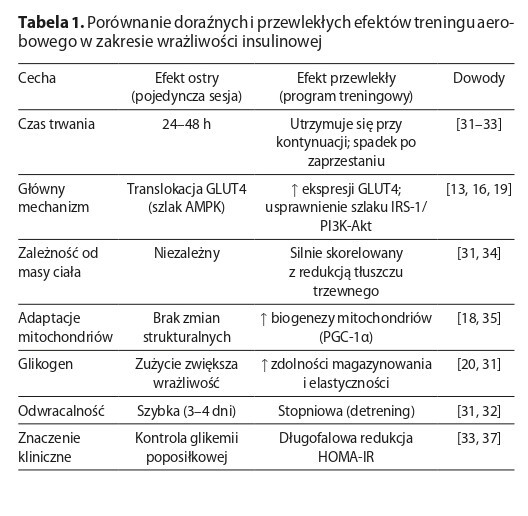
Trening aerobowy poprawia wrażliwość insulinową poprzez ostry, niezależny od insuliny mechanizm translokacji GLUT4 (szlak AMPK) oraz przewlekłe adaptacje: wzrost ekspresji GLUT4, usprawnienie sygnalizacji IRS-1/PI3K-Akt i biogenezę mitochondriów. Ćwiczenia redukują stan zapalny i ektopową akumulację tłuszczu oraz poprawiają profil lipidowy. Efekt pojedynczej sesji utrzymuje się 24–48 h, natomiast programy 8–16-tygodniowe wywołują trwalsze adaptacje. Umiarkowana intensywność treningu (50–70% VO₂max) wydaje się optymalna pod względem jego skuteczności i bezpieczeństwa.
Podsumowanie:
Trening aerobowy stanowi skuteczną, wieloukładową interwencję terapeutyczną w IO. Jego efekty są zależne od dawki i wymagają systematyczności, co uzasadnia włączenie do terapii zaburzeń metabolicznych regularnej aktywności tlenowej jako podstawowego elementu leczenia.
Insulinooporność (IO) jest kluczowym zaburzeniem metabolicznym prowadzącym do cukrzycy typu 2 i chorób sercowo-naczyniowych. Celem pracy była analiza aktualnych dowodów dotyczących wpływu treningu aerobowego na wrażliwość insulinową oraz identyfikacja optymalnych parametrów wysiłku.
Metody przeglądu:
Przeprowadzono przegląd narracyjny z elementami strategii systematycznej. Przeszukano bazy PubMed, Google Scholar, SpringerLink i MDPI (2018–2026). Do przeglądu włączono RCT, badania kliniczne i metaanalizy oceniające wpływ strukturalnego treningu aerobowego na zwalidowane wskaźniki wrażliwości insulinowej (m.in. HOMA-IR, klamrę metaboliczną, OGTT).
Opis stanu wiedzy:
Trening aerobowy poprawia wrażliwość insulinową poprzez ostry, niezależny od insuliny mechanizm translokacji GLUT4 (szlak AMPK) oraz przewlekłe adaptacje: wzrost ekspresji GLUT4, usprawnienie sygnalizacji IRS-1/PI3K-Akt i biogenezę mitochondriów. Ćwiczenia redukują stan zapalny i ektopową akumulację tłuszczu oraz poprawiają profil lipidowy. Efekt pojedynczej sesji utrzymuje się 24–48 h, natomiast programy 8–16-tygodniowe wywołują trwalsze adaptacje. Umiarkowana intensywność treningu (50–70% VO₂max) wydaje się optymalna pod względem jego skuteczności i bezpieczeństwa.
Podsumowanie:
Trening aerobowy stanowi skuteczną, wieloukładową interwencję terapeutyczną w IO. Jego efekty są zależne od dawki i wymagają systematyczności, co uzasadnia włączenie do terapii zaburzeń metabolicznych regularnej aktywności tlenowej jako podstawowego elementu leczenia.
Introduction and objective:
Insulin resistance (IR) is a key metabolic impairment leading to type 2 diabetes and cardiovascular disease. The aim of this study is to analyze current evidence on the impact of aerobic training on insulin sensitivity and identify optimal exercise parameters for therapeutic efficacy.
Review methods:
A narrative review with systematic elements was performed using PubMed, Google Scholar, SpringerLink, and MDPI (2018–2026). The study included RCTs, clinical trials, and meta-analyses evaluating the effect of structured aerobic training on validated insulin sensitivity markers, such as HOMA-IR, the hyperinsulinemic-euglycemic clamp, and OGTT
Brief description of the state of knowledge:
Aerobic exercise improves insulin sensitivity through acute, insulinindependent GLUT4 translocation via the AMPK pathway and chronic adaptations like increased GLUT4 expression, enhanced IRS-1/PI3K-Akt signalling, and mitochondrial biogenesis. Training reduces systemic inflammation and ectopic fat accumulation while improving lipid profiles. Single-session effects typically last 24–48 hours, but 8–16 week programmes induce more permanent physiological adaptations. Research indicates that moderate intensity, specifically 50–70% of VO₂max, is optimal for both safety and metabolic effectiveness.
Summary:
Aerobic training is a highly effective, multi-systemic intervention for insulin resistance. Its metabolic benefits are dose-dependent and require long-term consistency to be maintained. Consequently, regular aerobic activity should be integrated as a foundational and indispensable component in the clinical treatment of metabolic disorders.
Insulin resistance (IR) is a key metabolic impairment leading to type 2 diabetes and cardiovascular disease. The aim of this study is to analyze current evidence on the impact of aerobic training on insulin sensitivity and identify optimal exercise parameters for therapeutic efficacy.
Review methods:
A narrative review with systematic elements was performed using PubMed, Google Scholar, SpringerLink, and MDPI (2018–2026). The study included RCTs, clinical trials, and meta-analyses evaluating the effect of structured aerobic training on validated insulin sensitivity markers, such as HOMA-IR, the hyperinsulinemic-euglycemic clamp, and OGTT
Brief description of the state of knowledge:
Aerobic exercise improves insulin sensitivity through acute, insulinindependent GLUT4 translocation via the AMPK pathway and chronic adaptations like increased GLUT4 expression, enhanced IRS-1/PI3K-Akt signalling, and mitochondrial biogenesis. Training reduces systemic inflammation and ectopic fat accumulation while improving lipid profiles. Single-session effects typically last 24–48 hours, but 8–16 week programmes induce more permanent physiological adaptations. Research indicates that moderate intensity, specifically 50–70% of VO₂max, is optimal for both safety and metabolic effectiveness.
Summary:
Aerobic training is a highly effective, multi-systemic intervention for insulin resistance. Its metabolic benefits are dose-dependent and require long-term consistency to be maintained. Consequently, regular aerobic activity should be integrated as a foundational and indispensable component in the clinical treatment of metabolic disorders.
Karbowiak KZ, Nawrat N, Makselan N, Anczyk A, Handzel KM, Wysoczański J. Wpływ treningu aerobowego na wrażliwość insulinową
u pacjentów z insulinoopornością. Med Og Nauk Zdr. 2026;32(2):127–133. doi:10.26444/monz/221600
REFERENCJE (47)
1.
Barber TM, Kyrou I, Randeva HS, et al. Mechanisms of Insulin Resistance at the Crossroad of Obesity with Associated Metabolic Abnormalities and Cognitive Dysfunction. Int J Mol Sci. 2021;22(2):546.
2.
Lee SH, et al. Insulin Resistance: From Mechanisms to Therapeutic Strategies. Diabetes Metab J. 2021;45(6):841–857.
3.
Yang W, et al. Long Noncoding RNAs in the Pathogenesis of Insulin Resistance. Int J Mol Sci. 2022;23(24):16054.
4.
Pliszka M, Szablewski L. Severe Insulin Resistance Syndromes: Clinical Spectrum and Management. Int J Mol Sci. 2025;26(10):5669.
5.
Ormazabal V, Nair S, Elfeky O, et al. Association between insulin resistance and the development of cardiovascular disease. Cardiovasc Diabetol. 2018;17(1):122.
6.
Duan M, Zhao X, Li S, et al. Metabolic score for insulin resistance (METS-IR) predicts all-cause and cardiovascular mortality in the general population: evidence from NHANES 2001–2018. Cardiovasc Diabetol. 2024;23(1):243.
7.
Mir MM, Jeelani M, Alharthi MH, et al. Unraveling the Mystery of Insulin Resistance: From Principle Mechanistic Insights and Consequences to Therapeutic Interventions. Int J Mol Sci. 2025;26(6):2770.
8.
Palma R, et al. The Role of Insulin Resistance in Fueling NAFLD Pathogenesis: From Molecular Mechanisms to Clinical Implications. J Clin Med. 2022;11(13):3649.
9.
Méndez-García HM, et al. Association of SNPs in carbohydrate metabolism genes with insulin resistance indicators in the Mexican population. Nutr Metab (Lond). 2025;22(1):1.
10.
Cui Y, Tang T, Lu CQ, et al. Insulin Resistance and Cognitive Impairment: Evidence From Neuroimaging. J Magn Reson Imaging. 2022;56(1):121–133.
11.
Richter EA, et al. A comprehensive view of muscle glucose uptake: regulation by insulin, contractile activity, and exercise. Physiol Rev. 2024;104(4):1419–1481.
12.
Hulett NA, et al. Glucose Uptake by Skeletal Muscle within the Contexts of Type 2 Diabetes and Exercise: An Integrated Approach. Nutrients. 2022;14(3):647.
13.
Kjøbsted R, Roll JLW, Jørgensen NO, et al. AMPK and TBC1D1 Regulate Muscle Glucose Uptake After, but Not During, Exercise and Contraction. Diabetes. 2019;68(7):1427–1440.
14.
Zhang T, Liu Y, Yang Y, et al. The Effect and Mechanism of Regular Exercise on Improving Insulin Impedance: Based on the Perspective of Cellular and Molecular Levels. Int J Mol Sci. 2025;26(8):4199.
15.
Swojnóg M, Barczewska M, Bieszczad D, et al. Aerobic Exercise as an Essential Component of Non-Pharmacological Management for Metabolic Syndrome – A Review. Qual Sport. 2026;50(1):67623.
16.
Evans PL, McMillin SL, Weyrauch LA, et al. Regulation of Skeletal Muscle Glucose Transport and Glucose Metabolism by Exercise Training. Nutrients. 2019;11(10):2432.
17.
Brooks GA. The Precious Few Grams of Glucose During Exercise. Int J Mol Sci. 2020;21(16):5733.
18.
Flockhart M, Nilsson LC, Tais S, et al. Excessive exercise training causes mitochondrial functional impairment and decreases glucose tolerance in healthy volunteers. Cell Metab. 2021;33(5):957–970.
19.
Flores-Opazo M, McGee SL, Hargreaves M. Exercise and GLUT4. Exerc Sport Sci Rev. 2020;48(3):110.
20.
Soo J, Raman A, Lawler NG, et al. The role of exercise and hypoxia on glucose transport and regulation. Eur J Appl Physiol. 2023;123(6):1147–1165.
21.
Henríquez-Olguin C, Knudsen JR, Raun SH, et al. Cytosolic ROS production by NADPH oxidase 2 regulates muscle glucose uptake during exercise. Nat Commun. 2019;10(1):4623.
22.
Park JS, Holloszy JO, Kim K, et al. Exercise Training-Induced PPARβ Increases PGC-1α Protein Stability and Improves Insulin-Induced Glucose Uptake in Rodent Muscles. Nutrients. 2020;12(3):652.
23.
Peifer-Weiß L, Al-Hasani H, Chadt A. AMPK and Beyond: The Signaling Network Controlling RabGAPs and Contraction-Mediated Glucose Uptake in Skeletal Muscle. Int J Mol Sci. 2024;25(4):1910.
24.
Guo Q, Li N, Shi H, et al. Aerobic Exercise Prevents High-Fat-Diet-Induced Adipose Tissue Dysfunction in Male Mice. Nutrients. 2024;16(20):3451.
25.
Kolahdouzi S, Talebi-Garakani E, Hamidian G, et al. Exercise training prevents high-fat diet-induced adipose tissue remodeling by promoting capillary density and macrophage polarization. Life Sci. 2019;220:32–43.
26.
Ahn C, Ryan BJ, Schleh MW, et al. Exercise training remodels subcutaneous adipose tissue in adults with obesity even without weight loss. J Physiol. 2022;600(9):2127–2146.
27.
Chen C, Zhang D, Ye M, et al. Effects of various exercise types on inflammatory response in individuals with overweight and obesity: a systematic review and network meta-analysis of randomized controlled trials. Int J Obes (Lond). 2025;49(1):214–225.
28.
Del Rosso S, Baraquet ML, Barale A, et al. Long-term effects of different exercise training modes on cytokines and adipokines in individuals with overweight/obesity and cardiometabolic diseases. Obes Rev. 2023;24(6):e13564.
29.
Ji LL, et al. An acute exercise at low to moderate intensity attenuated postprandial lipemia and insulin responses. J Exerc Sci Fit. 2023;21(1):1–10.
30.
Collins KA, Ross LM, Slentz CA, et al. Differential Effects of Amount, Intensity, and Mode of Exercise Training on Insulin Sensitivity and Glucose Homeostasis: A Narrative Review. Sports Med Open. 2022;8(1):90.
31.
Ryan BJ, Schleh MW, Ahn C, et al. Moderate-Intensity Exercise and High-Intensity Interval Training Affect Insulin Sensitivity Similarly in Obese Adults. J Clin Endocrinol Metab. 2020;105(8):e2941–e2959.
32.
Fisher G, Gower BA, Ovalle F, et al. Acute Effects of Exercise Intensity on Insulin Sensitivity under Energy Balance. Med Sci Sports Exerc. 2019;51(5):988.
33.
Møller PM, Kjøbsted R, Petersen MH, et al. Effect of acute exercise and exercise training on the ability of insulin to clear branched-chain amino acids from plasma in obesity and type 2 diabetes. Diabetologia. 2025;68(9):1789–1800.
34.
Engin B, Willis SA, Malaikah S, et al. The effect of exercise training on adipose tissue insulin sensitivity: A systematic review and meta-analysis. Obes Rev. 2022;23(6):e13445.
35.
Li N, Shi H, Guo Q, et al. Aerobic Exercise Prevents Chronic Inflammation and Insulin Resistance in Skeletal Muscle of High-Fat Diet Mice. Nutrients. 2022;14(18):3730.
36.
Zhang L, Liu X, Hu J, et al. Aerobic exercise attenuates high-fat diet-induced glycometabolism impairments in skeletal muscle of rat: role of EGR-1/PTP1B signaling pathway. Nutr Metab (Lond). 2024;21(1):113.
37.
Battista F, Ermolao A, van Baak MA, et al. Effect of exercise on cardiometabolic health of adults with overweight or obesity. Obes Rev. 2021;22(7):e13269.
38.
Ding L, Huang J, Chen B, et al. Effects of Aerobic Exercise Training in Hypoxia Versus Normoxia on Body Composition and Metabolic Health in Overweight and/or Obese Populations. Sports Med Open. 2025;11(1):111.
39.
Horváth J, Seres I, Paragh G, et al. Effect of Low- and Moderate-Intensity Aerobic Training on Body Composition Cardiorespiratory Functions, Biochemical Risk Factors and Adipokines in Morbid Obesity. Nutrients. 2024;16(24):4251.
40.
Lee D, Brellenthin AG, Lanningham-Foster LM, et al. Aerobic, resistance, or combined exercise training and cardiovascular risk profile in overweight or obese adults. Eur Heart J. 2024;45(13):1127–1142.
41.
Soltani S, Yazdanpanah Z, Razmpoosh E, et al. The Effect of Aerobic or Resistance Exercise Combined With a Low-Calorie Diet Versus Diet Alone on Cardiometabolic Outcomes in Adults with Overweight and Obesity. Nutr Rev. 2025;83(4):nuaf065.
42.
Bo T, Gao L, Yao Z, et al. Hepatic selective insulin resistance at the intersection of insulin signaling and metabolic dysfunction-associated steatotic liver disease. Cell Metab. 2024;36(5):947–968.
43.
Kullmann S, Goj T, Veit R, et al. Exercise restores brain insulin sensitivity in sedentary adults who are overweight and obese. JCI Insight. 2022;7(18):161498.
44.
Ruegsegger GN, Vanderboom PM, Dasari S, et al. Exercise and metformin counteract altered mitochondrial function in the insulin-resistant brain. JCI Insight. 2019;4(18):130681.
45.
Loh R, Stamatakis E, Folkerts D, et al. Effects of Interrupting Prolonged Sitting with Physical Activity Breaks on Blood Glucose, Insulin and Triacylglycerol Measures. Sports Med. 2020;50(2):295–330.
46.
Clavero-Jimeno A, Dote-Montero M, Migueles JH, et al. Impact of lifestyle moderate-to-vigorous physical activity timing on glycemic control in sedentary adults with overweight/obesity and metabolic impairments. Obesity (Silver Spring). 2024;32(8):1465–1473.
47.
Mancilla R, Krook A, Schrauwen P, et al. Diurnal Regulation of Peripheral Glucose Metabolism: Potential Effects of Exercise Timing. Obesity (Silver Spring). 2020;28(S2):S38–S45.
Udostępnij
ARTYKUŁ POWIĄZANY
| eISSN: | 2084-4905 |
| ISSN: | 2083-4543 |

Przetwarzamy dane osobowe zbierane podczas odwiedzania serwisu. Realizacja funkcji pozyskiwania informacji o użytkownikach i ich zachowaniu odbywa się poprzez dobrowolnie wprowadzone w formularzach informacje oraz zapisywanie w urządzeniach końcowych plików cookies (tzw. ciasteczka). Dane, w tym pliki cookies, wykorzystywane są w celu realizacji usług, zapewnienia wygodnego korzystania ze strony oraz w celu monitorowania ruchu zgodnie z Polityką prywatności. Dane są także zbierane i przetwarzane przez narzędzie Google Analytics (więcej).
Możesz zmienić ustawienia cookies w swojej przeglądarce. Ograniczenie stosowania plików cookies w konfiguracji przeglądarki może wpłynąć na niektóre funkcjonalności dostępne na stronie.
Możesz zmienić ustawienia cookies w swojej przeglądarce. Ograniczenie stosowania plików cookies w konfiguracji przeglądarki może wpłynąć na niektóre funkcjonalności dostępne na stronie.