
RESEARCH PAPER
The effect of arduous (microclimate, lighting) and harmful (noise) factors on the levels of occupational burnout in surgical nurses

1
Collegium Medicum, The Jan Kochanowski University, Kielce, Polska
2
Collegium Medicum, Jan Kochanowski University, Kielce, Poland
3
John Paul II District Hospital in Włoszczowa, Healthcare Facility, John Paul II District Hospital, Włoszczowa, Poland
4
Clinic of Orthopedics and Traumatology, State Medical Institute of the Ministry of Interior and Administration - State Research Institute, Polska
5
Faculty of Medicine, Lazarski University, Polska
Corresponding author
Jarosław Piotr Chmielewski
Katedra Zdrowia Publicznego, Akademia Medyczna Nauk Stosowanych i Holistycznych, Al. Jerozolimskie 133 A, 02-304, Warszawa, Polska
Katedra Zdrowia Publicznego, Akademia Medyczna Nauk Stosowanych i Holistycznych, Al. Jerozolimskie 133 A, 02-304, Warszawa, Polska
Med Og Nauk Zdr. 2026;32(1):54-61

KEYWORDS
TOPICS
ABSTRACT
Introduction and objective:
Harmful factors may lead to a deterioration of health classified as occupational disease, while arduous factors may result in poor well-being or fatigue, but do not lead to permanent health damage. Occupational burnout syndrome poses a serious threat to the health of employees. The purpose of the present paper was to evaluate the effect of arduous (microclimate, lighting) and harmful (noise) factors on the level of occupational burnout in a group of surgical nurses.
Material and methods:
Studies of burdensome and harmful health factors in operating rooms, including measurements of electric lighting intensity, moderate microclimate, and noise, were conducted by an accredited laboratory in selected operating theaters in hospitals in the Świętokrzyskie region. The study group consisted of 110 professionally active surgical nurses. The Link Burnout Questionnaire (LBQ) was used for the survey.
Results:
Work environment measurements conducted in selected operating rooms by an accredited laboratory confirm that factors such as microclimate, lighting, and noise meet the requirements for operating rooms. The average percentage of participants dissatisfied with the thermal conditions in the studied operating rooms was 8.33%. The highest light intensity in the central zone was found on the operating table, reaching 16,485.5 lux. The average daily noise exposure level was 56.2 dB.
Conclusions:
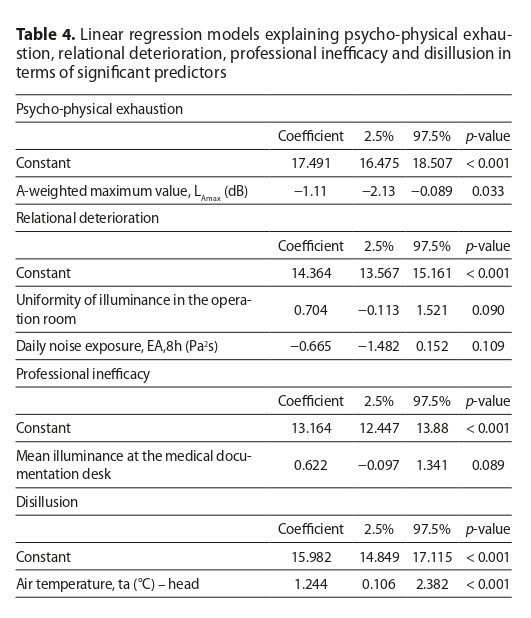
A study of the impact of harmful and burdensome factors revealed their impact on psychophysical exhaustion and disillusionment among nursing staff. Increased temperature and uneven lighting contributed to increased psychophysical exhaustion and disillusionment in the study group.
Harmful factors may lead to a deterioration of health classified as occupational disease, while arduous factors may result in poor well-being or fatigue, but do not lead to permanent health damage. Occupational burnout syndrome poses a serious threat to the health of employees. The purpose of the present paper was to evaluate the effect of arduous (microclimate, lighting) and harmful (noise) factors on the level of occupational burnout in a group of surgical nurses.
Material and methods:
Studies of burdensome and harmful health factors in operating rooms, including measurements of electric lighting intensity, moderate microclimate, and noise, were conducted by an accredited laboratory in selected operating theaters in hospitals in the Świętokrzyskie region. The study group consisted of 110 professionally active surgical nurses. The Link Burnout Questionnaire (LBQ) was used for the survey.
Results:
Work environment measurements conducted in selected operating rooms by an accredited laboratory confirm that factors such as microclimate, lighting, and noise meet the requirements for operating rooms. The average percentage of participants dissatisfied with the thermal conditions in the studied operating rooms was 8.33%. The highest light intensity in the central zone was found on the operating table, reaching 16,485.5 lux. The average daily noise exposure level was 56.2 dB.
Conclusions:
A study of the impact of harmful and burdensome factors revealed their impact on psychophysical exhaustion and disillusionment among nursing staff. Increased temperature and uneven lighting contributed to increased psychophysical exhaustion and disillusionment in the study group.
REFERENCES (27)
1.
Grochowska A, Kubik B, Romanowska U, et al. Wypalenie zawodowe u pielęgniarek. Medical Studies/Studia Medyczne. 2018;34(3):189–195. doi:10.5114/ms.2018.78681.
2.
Wilczek-Rużyczka E, Iskra-Golec I. Occupational burnout and stress in context of the attitude towards shiftwork and work satisfaction amongst nurses. Public Health Gov. 2016;14(1):2–37. doi:10.4467/20842627OZ.16.005.5567.
3.
Dall’Ora C, Ball J, Reinius M, Griffiths P. Burnout in nursing: a theoretical review. Human Res Health. 2020;18(1):41. doi:10.1186/s12960-020-00469-9.
4.
Chmielewski J, Dziechciaż M, Czarny-Działak M, i wsp. Środowiskowe zagrożenia zdrowia występujące w procesie pracy. Med Środow/Environl Med. 2017;20(2):52–61. doi:10.19243/2017207.
5.
Rozporządzenie Ministra Gospodarki i Pracy z dnia 5 sierpnia 2005 r. w sprawie bezpieczeństwa i higieny pracy przy pracach związanych z narażeniem na hałas lub drgania mechaniczne. DzU z 2005 r. nr 57, poz. 1318.
6.
Rozporządzenie Ministra Zdrowia z dnia 30 grudnia 2004 r. w sprawie bezpieczeństwa i higieny pracy związanej z występowaniem w miejscu pracy czynników chemicznych. DzU 2016 poz. 1488.
7.
Rozporządzenie Rady Ministrów z dnia 10 września 1996 r. w sprawie wykazu prac wzbronionych kobietom. DzU z 1996 r. nr 114, poz. 545, z późn. zm.
8.
Rozporządzenie Ministra Rodziny, Pracy i Polityki Społecznej z dnia 12 czerwca 2018 r. w sprawie najwyższych dopuszczalnych stężeń i natężeń czynników szkodliwych dla zdrowia w środowisku pracy. DzU 2018 poz.1286.
9.
Rozporządzenie Ministra Zdrowia z dnia 2 lutego 2011 r. w sprawie badań i pomiarów czynników szkodliwych dla zdrowia w środowisku pracy. DzU z 2011 r. nr 33, poz. 166.
10.
Rozporządzenie Ministra Zdrowia i Opieki Społecznej z dnia 30 maja 1996 r. w sprawie przeprowadzania badań lekarskich pracowników, zakresu profilaktycznej opieki zdrowotnej nad pracownikami oraz orzeczeń lekarskich wydawanych do celów przewidzianych w Kodeksie pracy. DzU z 1996 r. nr 69, poz. 332, z późn. zm.
11.
Rozporządzenie Ministra Pracy i Polityki Socjalnej z dnia 26 września 1997 r. w sprawie ogólnych przepisów bezpieczeństwa i higieny pracy. DzU z 2003 r. nr 169, poz. 1650 (tekst jedn.), zm. DzU z 2008 r. nr 108, poz. 690.
12.
Polski Komitet Normalizacyjny. PN-EN 12464-1. Technika świetlna – Oświetlenie miejsc pracy. Część 1. Miejsca pracy wewnątrz pomieszczeń. Warszawa: PKN; 2006.
13.
Polski Komitet Normalizacyjny. PN-EN 60601-2-41:2010. Medyczne urządzenia elektryczne. Część 2–41: Wymagania szczegółowe dotyczące bezpieczeństwa podstawowego oraz funkcjonowania zasadniczego opraw chirurgicznych i opraw diagnostycznych. Warszawa: PKN; 2010.
14.
Golvani J, Roos L, Henricson M. Operating room nurses' experiences of limited access to daylight in the workplace – a qualitative interview study. BMC Nurs. 2021;20(1):227. doi:10.1186/s12912-021-00751-8.
15.
Curlin J, Herman CK. Current State of Surgical Lighting. Surg J (N Y). 2020;6(2):e87-e97. doi:10.1055/s-0040-1710529.
16.
Rozporządzenie Ministra Zdrowia z dnia 26 marca 2019 r. w sprawie szczegółowych wymagań, jakim powinny odpowiadać pomieszczenia i urządzenia podmiotu wykonującego działalność leczniczą. DzU z 2019 r. poz. 595.
17.
Sadrizadeh S, Aganovic A, Bogdan A, et al. A systematic review of operating room ventilation. J Build Engin. 2021;40:102693. doi:10.1016/j.jobe.2021.102693.
18.
Deiana G, Arghittu A, Dettori M, et al. Ten-Year Evaluation of Thermal Comfort in Operating Rooms. Healthcare (Basel). 2022;10(2):307. doi:10.3390/healthcare10020307.
19.
Jaworowska A. LBQ kwestionariusz wypalenia zawodowego Massimo Satinello. Warszawa: Pracownia Testów Psychologicznych PTP; 2014.
20.
Zhou B, Wang A, Ren H, et al. Experimental study of thermal comfort by variable temperature and velocity air supply system in operating room. Build Environ. 2025;277:112927. doi:10.1016/j.buildenv.2025.112927.
21.
Sadrizadeh S, Aganovic A, Bogdan A, et al. A systematic review of operating room ventilation. J Build Engin. 2021;40:102694. doi:10.1016/j.jobe.2021.102693.
22.
Wang A, Wang SC, Peng F, et al. Field questionnaire survey on thermal comfort of medical personnel in operating rooms for hospitals in Nanjing. Ener Build. 2025;332:115423. doi:10.1016/j.enbuild.2025.115423.
23.
Golvani J, Roos L, Henricson M. Operating room nurses’ experiences of limited access to daylight in the workplace – a qualitative interview study. BMC Nurs. 2021;20:227. doi:10.1186/s12912-021-00751-8.
24.
Hemphälä H, Osterhaus W, Larsson P, et al. Towards better lighting recommendations for open surgery. Lighting Res Technol. 2020;52(7):856–882. doi:10.1177/1477153520903355.
25.
D'Alicandro AC, Mauro A. Air change per hour and inlet area: Effects on ultrafine particle concentration and thermal comfort in an operating room. J Aerosol Sci. 2023;171:106183. doi:10.1016/j.jaerosci.2023.106183.
26.
Ferramosca FMP, De Maria M, Ivziku D, et al. Nurses’ Organization of Work and Its Relation to Workload in Medical Surgical Units: A Cross-Sectional Observational Multi-Center Study. Healthcare. 2023; 11(2):156. doi:10.3390/healthcare11020156.
27.
Morvati D, Solbakken R, Vaag J, et al. Nurses’ and nurse leaders’ perspectives on a health-promoting work environment: a meta-ethnographic study. Inter J Qualitative Stud Health Well-Being. 2025;20(1):2460255. doi:10.1080/17482631.2025.2460255.
Share
RELATED ARTICLE
| eISSN: | 2084-4905 |
| ISSN: | 2083-4543 |

We process personal data collected when visiting the website. The function of obtaining information about users and their behavior is carried out by voluntarily entered information in forms and saving cookies in end devices. Data, including cookies, are used to provide services, improve the user experience and to analyze the traffic in accordance with the Privacy policy. Data are also collected and processed by Google Analytics tool (more).
You can change cookies settings in your browser. Restricted use of cookies in the browser configuration may affect some functionalities of the website.
You can change cookies settings in your browser. Restricted use of cookies in the browser configuration may affect some functionalities of the website.