
RESEARCH PAPER
Subjective assessment of quality of life in patients with multiple sclerosis
1
Institute of Public Health Department of Environmental Health, Faculty of Health Sciences Jagiellonian University Medical College, Polska
Corresponding author
Monika Ścibor
Instytut Zdrowia Publicznego, Katedra Zdrowia Środowiskowego, Uniwersytet Jagielloński – Collegium Medicum, Wydział Nauk o Zdrowiu, ul. Skawińska 8, 31-066 Kraków, Polska
Instytut Zdrowia Publicznego, Katedra Zdrowia Środowiskowego, Uniwersytet Jagielloński – Collegium Medicum, Wydział Nauk o Zdrowiu, ul. Skawińska 8, 31-066 Kraków, Polska
Med Og Nauk Zdr. 2026;32(1):69-74

KEYWORDS
TOPICS
ABSTRACT
Introduction and objective:
Multiple sclerosis is an autoimmune disease that affects nearly 3 million people worldwide. It is a progressive condition which has a significant impact on various spheres of life. The aim of this study is to deepen practical knowledge about the subjective limitations in meeting the requirements of daily functioning by patients with multiple sclerosis
Material and methods:
The study involved 153 participants: 115 women and 38 men with a declared diagnosis of multiple sclerosis. An anonymous survey based on the MSQOL-54 Quality of Life Assessment Questionnaire was used as a research tool. This questionnaire is a multidimensional tool for assessing health-related quality of life specific to multiple sclerosis.
Results:
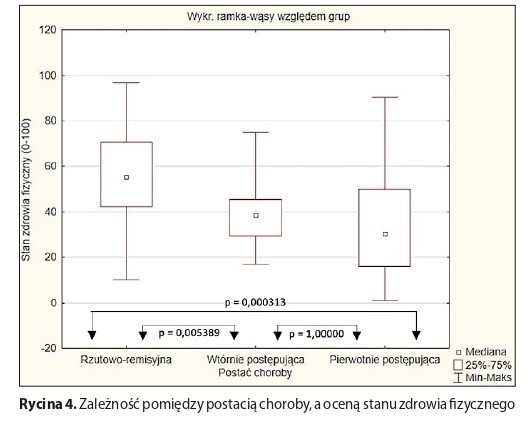
Multiple sclerosis affects both physical and mental health, and the overall quality of life reported by respondents was on a low level (median=50). Gender, age, time elapsed from diagnosis and the identified form of the disease exert a significant effect on the quality of life of patients (p<0.05). The wide range of replies suggests that patients evaluate their quality of life and health status differently. Depending on individual experiences and the diversity of symptoms, coping with the disease may be perceived at different levels. Over time, patients experience numerous difficulties and face increasing health problems.
Conclusions:
Conducting studies to assess the quality of life of patients with multiple sclerosis is necessary for proper management of the disease and coordination of the therapeutic pathway. People suffering from multiple sclerosis usually have a lower quality of life, than the rest of the population, and require an individual approach and understanding in order to tailor care to their needs.
Multiple sclerosis is an autoimmune disease that affects nearly 3 million people worldwide. It is a progressive condition which has a significant impact on various spheres of life. The aim of this study is to deepen practical knowledge about the subjective limitations in meeting the requirements of daily functioning by patients with multiple sclerosis
Material and methods:
The study involved 153 participants: 115 women and 38 men with a declared diagnosis of multiple sclerosis. An anonymous survey based on the MSQOL-54 Quality of Life Assessment Questionnaire was used as a research tool. This questionnaire is a multidimensional tool for assessing health-related quality of life specific to multiple sclerosis.
Results:
Multiple sclerosis affects both physical and mental health, and the overall quality of life reported by respondents was on a low level (median=50). Gender, age, time elapsed from diagnosis and the identified form of the disease exert a significant effect on the quality of life of patients (p<0.05). The wide range of replies suggests that patients evaluate their quality of life and health status differently. Depending on individual experiences and the diversity of symptoms, coping with the disease may be perceived at different levels. Over time, patients experience numerous difficulties and face increasing health problems.
Conclusions:
Conducting studies to assess the quality of life of patients with multiple sclerosis is necessary for proper management of the disease and coordination of the therapeutic pathway. People suffering from multiple sclerosis usually have a lower quality of life, than the rest of the population, and require an individual approach and understanding in order to tailor care to their needs.
REFERENCES (32)
1.
Kozubski W, Liberski PP, red. Neurologia: Podręcznik dla studentów medycyny. Warszawa: PZWL Wydawnictwo Lekarskie; 2024.
2.
Bonek R, red. Stwardnienie rozsiane: Od chemokin do przeciwciał monoklonalnych. Warszawa: PZWL Wydawnictwo Lekarskie; 2023:153–162.
3.
Kheradmand M, Afshari M, Nasehi MM, Aghaei I, Shabani M, Farshidi F, Moosazadeh M. Prevalence of subtypes of multiple sclerosis and the most common clinical symptoms in Iranian patients: A meta-analysis. Clin Exp Neuroimmunol. 2018;10(1):33–40. https://doi.org/10.1111/cen3.1....
4.
Solaro C, Gamberini G, Masuccio FG. Depression in multiple sclerosis: Epidemiology, aetiology, diagnosis and treatment. CNS Drugs. 2018;32(2):117–133. https://doi.org/10.1007/s40263....
5.
Gonzales N. Multiple sclerosis. Case study. Radiopaedia. 2022. https://doi.org/10.53347/rID-1....
6.
López-Gómez J, Sacristán Enciso B, Caro Miró MA, Querol Pascual MR. Clinically isolated syndrome: Diagnosis and risk of developing clinically definite multiple sclerosis. Neurologia. 2023;38(9):663–670. https://doi.org/10.1016/j.nrle....
7.
Medeiros Junior WLG, Demore CC, Mazaro LP, de Souza MFN, Parolin LF, Melo LH, Werka Junior CR, Gonçalves MVM. Urinary tract infection in patients with multiple sclerosis: An overview. Mult Scler Relat Disord. 2020;46:102462. https://doi.org/10.1016/j.msar....
8.
Ostrowski A. Nietrzymanie moczu i parcia naglące u kobiet chorujących na stwardnienie rozsiane. Med Educ. 2020;9(3):12–16.
9.
Belbasis L, Bellou V. Environmental factors and risk of multiple sclerosis: Findings from meta-analyses and Mendelian randomization studies. Mult Scler J. 2019;26(4):N/A. https://doi.org/10.1177/135245....
10.
Soldan SS, Lieberman PM. Epstein–Barr virus and multiple sclerosis. Nat Rev Microbiol. 2023;21(1):51–59. https://doi.org/10.1038/s41579....
11.
Rosso M, Chitnis T. Association between cigarette smoking and multiple sclerosis: A review. JAMA Neurol. 2020;77(2):245–253.
12.
Petersen ER, Oturai AB, Koch-Henriksen N, Magyari M, Sørensen PS, Sellebjerg F, Søndergaard HB. Smoking affects the interferon beta treatment response in multiple sclerosis. Neurology. 2018;90(7):593–600. https://doi.org/10.1212/WNL.00....
13.
Arneth B. Multiple sclerosis and smoking. Am J Med. 2020;133(7):783–788. https://doi.org/10.1016/j.amjm....
15.
Ferrè L, Filippi M, Esposito F. Involvement of genetic factors in multiple sclerosis. Front Cell Neurosci. 2020;14:612953. https://doi.org/10.3389/fncel.....
16.
Engelhard J, Oleske DM, Schmitting S, Wells KE, Talapala S, Barbato LM. Multiple sclerosis by phenotype in Germany. Mult Scler Relat Disord. 2022;57:103326. https://doi.org/10.1016/j.msar....
17.
Dobson R, Giovannoni G. Multiple sclerosis – a review. Eur J Neurol. 2019;26:27–40.
18.
Rosato R, Testa S, Bertolotto A, Confalonieri P, Patti F, Lugaresi A, Grasso MG, Toscano A, Giordano A, Solari A. Development of a short version of MSQOL-54 using factor analysis and item response theory. PLoS One. 2016;11(4):e0153466. https://doi.org/10.1371/journa....
19.
Vickrey BG. Multiple Sclerosis Quality of Life (MSQOL)-54 Instrument. Los Angeles: University of California, Los Angeles; 1995.
20.
Gil-González I, Martín-Rodríguez A, Conrad R. Quality of life in adults with multiple sclerosis: A systematic review. BMJ Open. 2020;10:e041249. https://doi.org/10.1136/bmjope....
21.
Snarska K, Karwowska M, Kapica-Topczewska K, Drozdowski W, Bachórzewska-Gajewska H. Quality of life in patients with multiple sclerosis. Nursing Problems / Problemy Pielęgniarstwa. 2015;23(3):349–356. doi:10.5603/PP.2015.0057.
22.
Rezapour A, Kia AA, Goodarzi S, Hasoumi M, Motlagh SN, Vahedi S. The impact of disease characteristics on multiple sclerosis patients’ quality of life. Epidemiol Health. 2017;39:e2017008. https://doi.org/10.4178/epih.e....
23.
Rzepińska M, Rzepiński Ł, Steinborn B. Stwardnienie rozsiane u kobiet – wybrane aspekty epidemiologiczne, kliniczno-terapeutyczne i macierzyńskie. Aktual Neurol. 2022;22(1):25–31.
24.
Lopez J, Perez-Rojo G, Noriega C, Sánchez-Cabaco A, Sitges E, Bonete B. Quality-of-life in older adults: its association with emotional distress and psychological wellbeing. BMC Geriatr. 2024;9(1):815. doi:10.1186/s12877-024-05401-7.
25.
Tabrizi FM, Radfar M. Fatigue, sleep quality, and disability in relation to quality of life in multiple sclerosis. Int J MS Care. 2015;17(6):268–274.
26.
Smelkowska A, Wilkiewicz M, Grabowska-Fudala B, Jaracz K. Przebieg opieki nad chorym ze stwardnieniem rozsianym w kontekście farmakoterapii. PNN. 2015;4(3):130–137.
27.
Ysrraelit MC, Fiol MP, Gaitán MI, Correale J. Quality of life assessment in multiple sclerosis: Different perception between patients and neurologists. Front Neurol. 2018;8:729.
28.
Dębińska M, Mraz M. Jakość życia osób chorujących na stwardnienie rozsiane – przegląd literatury. Medycyna Rodzinna. 2018;2A:41–45. https://doi.org/10.25121/MR.20....
29.
Pokryszko-Dragan A, Nowakowska-Kotas M, Ciastoń R, et al. Vocational activity for patients with multiple sclerosis. Neurol Neurochir Pol. 2022;56(5):435–440. https://doi.org/10.5603/PJNNS.....
30.
Rosiak K, Zagożdżon P. Quality of life and social support in patients with multiple sclerosis. Psychiatr Pol. 2017;51(5):923–935.
31.
Mielnik A. Rola psychologa w procesie diagnozy i rehabilitacji osób chorych na stwardnienie rozsiane. Aktual Neurol. 2018;18(1):27–33.
32.
Tarasiuk J, Kapica-Topczewska K, Czarnowska A, et al. Improving quality of life in Polish patients with multiple sclerosis: a multicentre analysis. Neurol Neurochir Pol. 2025;59(4):403–412. https://doi.org/10.5603/pjnns.....
Share
RELATED ARTICLE
| eISSN: | 2084-4905 |
| ISSN: | 2083-4543 |

We process personal data collected when visiting the website. The function of obtaining information about users and their behavior is carried out by voluntarily entered information in forms and saving cookies in end devices. Data, including cookies, are used to provide services, improve the user experience and to analyze the traffic in accordance with the Privacy policy. Data are also collected and processed by Google Analytics tool (more).
You can change cookies settings in your browser. Restricted use of cookies in the browser configuration may affect some functionalities of the website.
You can change cookies settings in your browser. Restricted use of cookies in the browser configuration may affect some functionalities of the website.