Online first
Bieżący numer
Archiwum
O czasopiśmie
Polityka etyki publikacyjnej
System antyplagiatowy
Instrukcje dla Autorów
Instrukcje dla Recenzentów
Rada Redakcyjna
Komitet Redakcyjny
Recenzenci
Wszyscy recenzenci
2025
2024
2023
2022
2021
2020
2019
2018
2017
2016
Kontakt
Bazy indeksacyjne
Klauzula przetwarzania danych osobowych (RODO)

PRACA PRZEGLĄDOWA
Nutrigenomika i epigenetyka w prewencji cukrzycy typu 2 (T2DM): przegląd literatury
1
Collegium Medicum, Andrzej Frycz Modrzewski University, Kraków, Poland
2
2nd Department of Internal Medicine with a Cardiac Intensive Care Unit, Stefan Żeromski Specialist Hospital, Kraków, Poland
3
Night and Holiday Healthcare Clinic, Arion Med Sp. z o.o., Gostynin, Poland
4
Faculty of Medical Sciences in Katowice, Medical University of Silesia, Katowice, Poland
5
Primary Health Care Clinic, MCM Górna, Łódź, Poland
6
Department of Internal Medicine, Metabolic Diseases, and Angiology, Prof. Leszek Giec Upper Silesian Medical Centre, Katowice, Poland
7
Faculty of Medical Sciences and Health Sciences, Kazimierz Pułaski University, Radom, Poland
8
Department of Internal Medicine and Nephrodiabetology, University Clinical Hospital No.2, Medical University, Łódż, Poland
9
Emergency Department, Bielański Hospital, Warsaw, Poland
10
Emergency Department, Specialist Hospital, Kościerzyna, Poland
Autor do korespondencji
Med Og Nauk Zdr. 2026;32(3):177-183

SŁOWA KLUCZOWE
DNA methylationmicroRNAepigeneticsnutrigenomicspersonalised nutritiontype 2 diabetes mellitus prevention
DZIEDZINY
STRESZCZENIE
Wprowadzenie i cel:
Cukrzyca typu 2 dotyczy ponad 500 mln dorosłych na świecie, przy czym odnotowuje się stały wzrost liczby zachorowań. Dieta kształtuje szlaki molekularne regulujące wrażliwość na insulinę, stan zapalny i metabolizm glukozy. Nutrigenomika bada interakcje między składnikami diety a genami, a epigenetyka koncentruje się na odwracalnych mechanizmach, takich jak metylacja DNA, modyfikacje histonów i ncRNA. Przegląd syntetyzuje dane z lat 2017–2025 dotyczące roli nutrigenomiki i epigenetyki w prewencji T2DM.
Metody przeglądu:
Przeprowadzono przegląd narracyjny PubMed/PMC, obejmujący badania z udziałem ludzi z lat 2017–2025 dotyczące nutrigenomiki, epigenetyki, diety i profilaktyki T2DM. Uwzględniono w nim przede wszystkim recenzowane badania kliniczne, kohortowe, mechanistyczne i przeglądowe, syntetyzując je tematycznie.
Opis stanu wiedzy:
Warianty genetyczne, takie jak TCF7L2, FTO i PPARG, wykazują niewielkie i niespójne interakcje dieta-gen. Zmiany epigenetyczne wynikające z diety wpływają na sygnalizację insulinową, metabolizm lipidów i szlaki zapalne, lecz zazwyczaj mają charakter krótkotrwały i obserwacyjny. Diety śródziemnomorskie i roślinne wiążą się z korzystniejszym profilem molekularnym, natomiast diety wysokotłuszczowe i wysokoglikemiczne – z profilem niekorzystnym. Wczesne próby personalizacji żywienia oparte na genomice, metabolomice lub mikrobiomie pokazują, że takie żywienie poprawia poposiłkową glikemię u części osób, ale często nie przewyższają standardowych zaleceń w populacji ogólnej. ?
Podsumowanie:
Nutrigenomika i epigenetyka umożliwiają głębsze rozumienie wpływu diety na ryzyko metaboliczne, jednak ich zastosowanie kliniczne pozostaje ograniczone. Efekty są niewielkie, zmienne między populacjami i rzadko powtarzalne. Potrzebne są długoterminowe, wieloetniczne badania wieloomiczne, aby potwierdzić biomarkery i ocenić, czy wartość predykcyjna lub terapeutyczna, którą wnoszą, przewyższa wartość uznanych strategii żywieniowych.
Cukrzyca typu 2 dotyczy ponad 500 mln dorosłych na świecie, przy czym odnotowuje się stały wzrost liczby zachorowań. Dieta kształtuje szlaki molekularne regulujące wrażliwość na insulinę, stan zapalny i metabolizm glukozy. Nutrigenomika bada interakcje między składnikami diety a genami, a epigenetyka koncentruje się na odwracalnych mechanizmach, takich jak metylacja DNA, modyfikacje histonów i ncRNA. Przegląd syntetyzuje dane z lat 2017–2025 dotyczące roli nutrigenomiki i epigenetyki w prewencji T2DM.
Metody przeglądu:
Przeprowadzono przegląd narracyjny PubMed/PMC, obejmujący badania z udziałem ludzi z lat 2017–2025 dotyczące nutrigenomiki, epigenetyki, diety i profilaktyki T2DM. Uwzględniono w nim przede wszystkim recenzowane badania kliniczne, kohortowe, mechanistyczne i przeglądowe, syntetyzując je tematycznie.
Opis stanu wiedzy:
Warianty genetyczne, takie jak TCF7L2, FTO i PPARG, wykazują niewielkie i niespójne interakcje dieta-gen. Zmiany epigenetyczne wynikające z diety wpływają na sygnalizację insulinową, metabolizm lipidów i szlaki zapalne, lecz zazwyczaj mają charakter krótkotrwały i obserwacyjny. Diety śródziemnomorskie i roślinne wiążą się z korzystniejszym profilem molekularnym, natomiast diety wysokotłuszczowe i wysokoglikemiczne – z profilem niekorzystnym. Wczesne próby personalizacji żywienia oparte na genomice, metabolomice lub mikrobiomie pokazują, że takie żywienie poprawia poposiłkową glikemię u części osób, ale często nie przewyższają standardowych zaleceń w populacji ogólnej. ?
Podsumowanie:
Nutrigenomika i epigenetyka umożliwiają głębsze rozumienie wpływu diety na ryzyko metaboliczne, jednak ich zastosowanie kliniczne pozostaje ograniczone. Efekty są niewielkie, zmienne między populacjami i rzadko powtarzalne. Potrzebne są długoterminowe, wieloetniczne badania wieloomiczne, aby potwierdzić biomarkery i ocenić, czy wartość predykcyjna lub terapeutyczna, którą wnoszą, przewyższa wartość uznanych strategii żywieniowych.
Introduction and objective:
Type 2 diabetes mellitus affects more than 500 million adults worldwide and continues to increase. Diet shapes molecular pathways regulating insulin sensitivity, inflammation and glucose metabolism. Nutrigenomics studies nutrient-gene interactions, while epigenetics focuses on reversible mechanisms, such as DNA methylation, histone modifications and non-coding RNAs. This review synthesises evidence from 2017–2025 on how these processes support T2DM prevention.
Review methods:
A targeted narrative search of PubMed and PubMed Central was conducted to identify recent human evidence published between 2017–2025 on nutrigenomics, epigenetics, diet and T2DM prevention. Peer-reviewed clinical, cohort, mechanistic and review studies were prioritised and synthesised thematically.
Brief description of the state of knowledge:
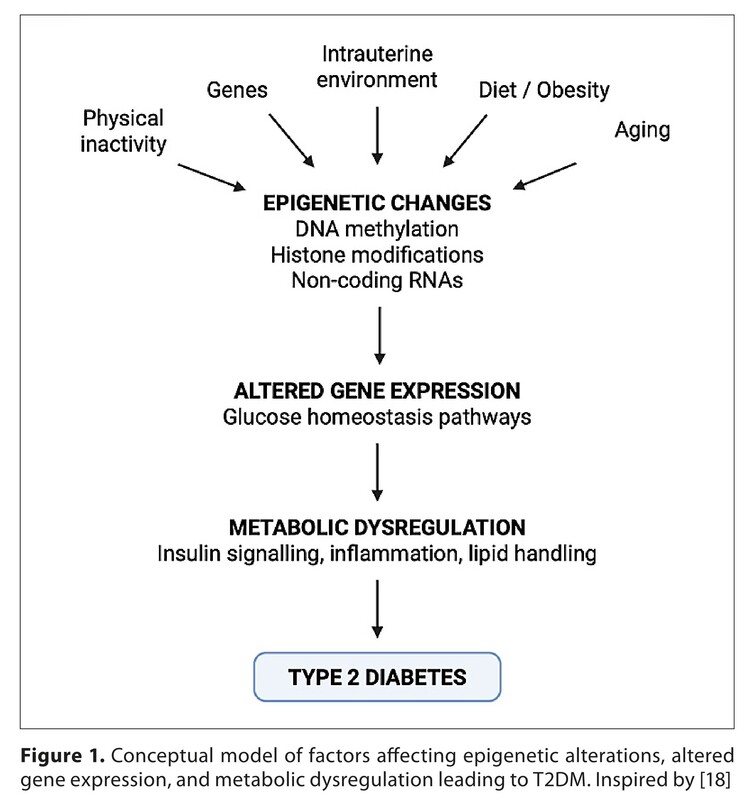
Genetic variants, such as TCF7L2, FTO and PPARG, show modest, inconsistent diet-gene effects. Diet-induced changes in DNA methylation and histone marks influence insulin signalling, lipid metabolism and inflammatory pathways, but mostly associative and short-term. Mediterranean and plant-based diets align with more favourable molecular profiles, while high-fat, high-GI diets show adverse signatures. Early personalised-nutrition trials using genomic, metabolomic or microbiome data improve postprandial glucose responses in some individuals, but often fail to outperform standard dietary recommendations in broader populations.
Summary:
Nutrigenomic and epigenetic research improves understanding of how diet shapes metabolic risk, although clinical applicability remains limited. Most effects are small, variable across populations, and not consistently reproduced. Long-term, multi-ethnic and multi-omics studies are needed to validate biomarkers and determine whether they add predictive or therapeutic value beyond established dietary strategies.
Type 2 diabetes mellitus affects more than 500 million adults worldwide and continues to increase. Diet shapes molecular pathways regulating insulin sensitivity, inflammation and glucose metabolism. Nutrigenomics studies nutrient-gene interactions, while epigenetics focuses on reversible mechanisms, such as DNA methylation, histone modifications and non-coding RNAs. This review synthesises evidence from 2017–2025 on how these processes support T2DM prevention.
Review methods:
A targeted narrative search of PubMed and PubMed Central was conducted to identify recent human evidence published between 2017–2025 on nutrigenomics, epigenetics, diet and T2DM prevention. Peer-reviewed clinical, cohort, mechanistic and review studies were prioritised and synthesised thematically.
Brief description of the state of knowledge:
Genetic variants, such as TCF7L2, FTO and PPARG, show modest, inconsistent diet-gene effects. Diet-induced changes in DNA methylation and histone marks influence insulin signalling, lipid metabolism and inflammatory pathways, but mostly associative and short-term. Mediterranean and plant-based diets align with more favourable molecular profiles, while high-fat, high-GI diets show adverse signatures. Early personalised-nutrition trials using genomic, metabolomic or microbiome data improve postprandial glucose responses in some individuals, but often fail to outperform standard dietary recommendations in broader populations.
Summary:
Nutrigenomic and epigenetic research improves understanding of how diet shapes metabolic risk, although clinical applicability remains limited. Most effects are small, variable across populations, and not consistently reproduced. Long-term, multi-ethnic and multi-omics studies are needed to validate biomarkers and determine whether they add predictive or therapeutic value beyond established dietary strategies.
INFORMACJE O RECENZOWANIU
Sprawdzono w systemie antyplagiatowym
REFERENCJE (41)
1.
Guzman-Vilca WC, Carrillo-Larco RM. Number of People with Type 2 Diabetes Mellitus in 2035 and 2050: A Modelling Study in 188 Countries. Curr Diabetes Rev. 2024;21(1):53–60. doi:10.2174/0115733998274323231230131843.
3.
Nilsson E, Ling C. DNA methylation links genetics, fetal environment, and an unhealthy lifestyle to the development of type 2 diabetes. Clin Epigenetics. 2017;9(1):105. doi:10.1186/s13148-017-0399-2.
4.
Brown MR, Matveyenko AV. It’s What and When You Eat: An Overview of Transcriptional and Epigenetic Responses to Dietary Perturbations in Pancreatic Islets. Front Endocrinol. 2022;13:842603. doi:10.3389/fendo.2022.842603.
5.
Ling C, Rönn T. Epigenetics in Human Obesity and Type 2 Diabetes. Cell Metab. 2019;29(5):1028–1044. doi:10.1016/j.cmet.2019.03.009.
6.
Dhawan S, Natarajan R. Epigenetics and Type 2 Diabetes Risk. Curr Diab Rep. 2019;19(8):47. doi:10.1007/s11892-019-1168-8.
7.
Prasad M, Rajagopal P, Devarajan N, et al. A comprehensive review on high -fat diet-induced diabetes mellitus: an epigenetic view. J Nutr Biochem. 2022;107:109037. doi:10.1016/j.jnutbio.2022.109037.
8.
Ekta, Gupta M, Kaur A, et al. Pathobiological and molecular connections involved in the high fructose and high fat diet induced diabetes associated nonalcoholic fatty liver disease. Inflamm Res. 2020;69(9):851–867. doi:10.1007/s00011-020-01373-7.
9.
Nicoletti CF, Assmann TS, Souza LL, et al. DNA Methylation and Non-Coding RNAs in Metabolic Disorders: Epigenetic Role of Nutrients, Dietary Patterns, and Weight Loss Interventions for Precision Nutrition. Lifestyle Genomics. 2024;17(1):151–165. doi:10.1159/000541000.
10.
Capetini VC, Quintanilha BJ, Garcia BREV, et al. Dietary modulation of microRNAs in insulin resistance and type 2 diabetes. J Nutr Biochem. 2024;133:109714. doi:10.1016/j.jnutbio.2024.109714.
11.
Jimenez-Lucena R, Alcala-Diaz JF, Roncero-Ramos I, et al. MiRNAs profile as biomarkers of nutritional therapy for the prevention of type 2 diabetes mellitus: From the CORDIOPREV study. Clin Nutr. 2021;40(3):1028–1038. doi:10.1016/j.clnu.2020.06.035.
12.
Rein M, Ben-Yacov O, Godneva A, et al. Effects of personalized diets by prediction of glycemic responses on glycemic control and metabolic health in newly diagnosed T2DM: a randomized dietary intervention pilot trial. BMC Med. 2022;20(1):56. doi:10.1186/s12916-022-02254-y.
13.
Lee DJ, Balaji S, Rotter JI, et al. Metabolomic Data May Support the Development of Personalized Nutrition Approaches to Type 2 Diabetes Management. Nutr Rev. 2025;83(7):1374–1377. doi:10.1093/nutrit/nuaf059.
14.
Gorini F, Tonacci A. The Complex Gene–Carbohydrate Interaction in Type 2 Diabetes: Between Current Knowledge and Future Perspectives. Nutrients. 2025;17(14):2350. doi:10.3390/nu17142350.
15.
Kapellou A, Salata E, Vrachnos DM, Papailia S, Vittas S. Gene–Diet Interactions in Diabetes Mellitus: Current Insights and the Potential of Personalized Nutrition. Genes. 2025;16(5):578. doi:10.3390/genes16050578.
16.
Popp CJ, Hu L, Kharmats AY, et al. Effect of a Personalized Diet to Reduce Postprandial Glycemic Response vs a Low-fat Diet on Weight Loss in Adults With Abnormal Glucose Metabolism and Obesity: A Randomized Clinical Trial. JAMA Netw Open. 2022;5(9):e2233760. doi:10.1001/jamanetworkopen.2022.33760.
17.
Kharmats AY, Popp C, Hu L, et al. A randomized clinical trial comparing low-fat with precision nutrition–based diets for weight loss: impact on glycemic variability and HbA1c. Am J Clin Nutr. 2023;118(2):443–451. doi:10.1016/j.ajcnut.2023.05.026.
18.
Walaszczyk E, Luijten M, Spijkerman AMW, et al. DNA methylation markers associated with type 2 diabetes, fasting glucose and HbA1c levels: a systematic review and replication in a case–control sample of the Lifelines study. Diabetologia. 2018;61(2):354–368. doi:10.1007/s00125-017-4497-7.
19.
Ibrahim HIM. Epigenetic Regulation of Obesity-Associated Type 2 Diabetes. Medicina (Mex). 2022;58(10):1366. doi:10.3390/medicina58101366.
20.
Gallardo-Alfaro L, Bibiloni MDM, Bouzas C, et al. Physical activity and metabolic syndrome severity among older adults at cardiovascular risk: 1-Year trends. Nutr Metab Cardiovasc Dis. 2021;31(10):2870–2886. doi:10.1016/j.numecd.2021.06.015.
21.
Adam TC, Drummen M, Macdonald I, et al. Association of Psychobehavioral Variables With HOMA-IR and BMI Differs for Men and Women With Prediabetes in the PREVIEW Lifestyle Intervention. Diabetes Care. 2021;44(7):1491–1498. doi:10.2337/dc21-0059.
22.
Drozdz D, Alvarez-Pitti J, Wójcik M, et al. Obesity and Cardiometabolic Risk Factors: From Childhood to Adulthood. Nutrients. 2021;13(11):4176. doi:10.3390/nu13114176.
23.
Zhu R, Larsen TM, Fogelholm M, et al. Dose-Dependent Associations of Dietary Glycemic Index, Glycemic Load, and Fiber With 3-Year Weight Loss Maintenance and Glycemic Status in a High-Risk Population: A Secondary Analysis of the Diabetes Prevention Study PREVIEW. Diabetes Care. 2021;44(7):1672–1681. doi:10.2337/dc20-3092.
24.
San-Cristobal R, Navas-Carretero S, Livingstone K, et al. Mediterranean Diet Adherence and Genetic Background Roles within a Web-Based Nutritional Intervention: The Food4Me Study. Nutrients. 2017;9(10):1107. doi:10.3390/nu9101107.
25.
Parrillo L, Spinelli R, Nicolò A, et al. Nutritional Factors, DNA Methylation, and Risk of Type 2 Diabetes and Obesity: Perspectives and Challenges. Int J Mol Sci. 2019;20(12):2983. doi:10.3390/ijms20122983.
26.
Urpi-Sarda M, Almanza-Aguilera E, Llorach R, et al. Non-targeted metabolomic biomarkers and metabotypes of type 2 diabetes: A cross-sectional study of PREDIMED trial participants. Diabetes Metab. 2019;45(2):167–174. doi:10.1016/j.diabet.2018.02.006.
27.
Wang X, Wang Z, Wu J, et al. Interactive associations of the INAFM2 rs67839313 variant and egg consumption with type 2 diabetes mellitus and fasting blood glucose in a Chinese population: A family-based study. Gene. 2021;770:145357. doi:10.1016/j.gene.2020.145357.
28.
Deng X, Niu L, Xiao J, et al. Involvement of intestinal flora and miRNA into the mechanism of coarse grains improving type 2 diabetes: an overview. J Sci Food Agric. 2023;103(9):4257–4267. doi:10.1002/jsfa.12270.
29.
Ling C. Epigenetic regulation of insulin action and secretion – role in the pathogenesis of type 2 diabetes. J Intern Med. 2020;288(2):158–167. doi:10.1111/joim.13049.
30.
Ouni M, Schürmann A. Epigenetic contribution to obesity. Mamm Genome. 2020;31(5–6):134–145. doi:10.1007/s00335-020-09835-3.
31.
Jazieh C, Arabi TZ, Asim Z, et al. Unraveling the epigenetic fabric of type 2 diabetes mellitus: pathogenic mechanisms and therapeutic implications. Front Endocrinol. 2024;15:1295967. doi:10.3389/fendo.2024.1295967.
32.
Amrom D, Schwartz SS. Maternal Metabolic Health, Lifestyle, and Environment – UnderstandingHow Epigenetics Drives Future Offspring Health. Curr Diabetes Rev. 2023;19(2):e220422203919. doi:10.2174/1573399818666220422085016.
33.
Tuncay C, Ergoren MC. A systematic review of precision nutrition and Mediterranean Diet: A personalized nutrition approaches for prevention and management of obesity related disorders. Clin Nutr ESPEN. 2020;38:61–64. doi:10.1016/j.clnesp.2020.04.005.
34.
Lorite Mingot D, Gesteiro E, Bastida S, Sánchez-Muniz FJ. Epigenetic effects of the pregnancy Mediterranean diet adherence on the offspring metabolic syndrome markers. J Physiol Biochem. 2017;73(4):495–510. doi:10.1007/s13105-017-0592-y.
35.
Park JH, Kim SH, Lee MS, Kim MS. Epigenetic modification by dietary factors: Implications in metabolic syndrome. Mol Aspects Med. 2017;54:58–70. doi:10.1016/j.mam.2017.01.008.
36.
Alcala-Diaz JF, Camargo A, Vals-Delgado C, et al. MiRNAs as biomarkers of nutritional therapy to achieve T2DM remission in patients with coronary heart disease: from the CORDIOPREV study. Nutr Diabetes. 2025;15(1):7. doi:10.1038/s41387-025-00362-1.
37.
Antwi J. Precision Nutrition to Improve Risk Factors of Obesity and Type 2 Diabetes. Curr Nutr Rep. 2023;12(4):679–694. doi:10.1007/s13668-023-00491-y.
38.
Saenz C, Salinas M, Rothman RL, White RO. Personalized Lifestyle Modifications for Improved Metabolic Health: The Role of Cultural Sensitivity and Health Communication in Type 2 Diabetes Management. J Am Nutr Assoc. 2025;44(3):198–211. doi:10.1080/27697061.2024.2413368.
39.
Ko J, Wang J, Du Y, et al. Personalized Behavioral Nutrition Among Older Asian Americans: Study Protocol. Nurs Res. 2021;70(4):317–322. doi:10.1097/NNR.0000000000000514.
40.
Zhang K, Fu Y, Gou W, et al. Quantification of personalized glycemic sensitivity to food and its potential for precision nutrition in a series of n-of-1 trials. Am J Clin Nutr. 2025;122(2):502–512. doi:10.1016/j.ajcnut.2025.04.015.
41.
Zhang X. Causal association between immunoglobulin G N-glycosylation patterns and diabetic complications: two-sample mendelian randomization. Diabetol Metab Syndr. 2025;17(1):284. doi:10.1186/s13098-025-01858-7.
| eISSN: | 2084-4905 |
| ISSN: | 2083-4543 |

Przetwarzamy dane osobowe zbierane podczas odwiedzania serwisu. Realizacja funkcji pozyskiwania informacji o użytkownikach i ich zachowaniu odbywa się poprzez dobrowolnie wprowadzone w formularzach informacje oraz zapisywanie w urządzeniach końcowych plików cookies (tzw. ciasteczka). Dane, w tym pliki cookies, wykorzystywane są w celu realizacji usług, zapewnienia wygodnego korzystania ze strony oraz w celu monitorowania ruchu zgodnie z Polityką prywatności. Dane są także zbierane i przetwarzane przez narzędzie Google Analytics (więcej).
Możesz zmienić ustawienia cookies w swojej przeglądarce. Ograniczenie stosowania plików cookies w konfiguracji przeglądarki może wpłynąć na niektóre funkcjonalności dostępne na stronie.
Możesz zmienić ustawienia cookies w swojej przeglądarce. Ograniczenie stosowania plików cookies w konfiguracji przeglądarki może wpłynąć na niektóre funkcjonalności dostępne na stronie.