
REVIEW PAPER
Wild native edible plants with antipyretic and antiviral properties suitable for use in field conditions

1
Collegium Medicum, Faculty of Medicine, Departament of Biochemistry, Andrzej Frycz Modrzewski Krakow Uniwersity, Polska
Corresponding author
Małgorzata Kalemba-Drożdż
Collegium Medicum, Wydział Lekarski, Zakład Biochemii, Uniwersytet Andrzeja Frycza Modrzewskiego w Krakowie, G. Herlinga Grudzińskiego 1, 30-705, Kraków, Polska
Collegium Medicum, Wydział Lekarski, Zakład Biochemii, Uniwersytet Andrzeja Frycza Modrzewskiego w Krakowie, G. Herlinga Grudzińskiego 1, 30-705, Kraków, Polska
Med Og Nauk Zdr. 2026;32(1):8-21

KEYWORDS
TOPICS
ABSTRACT
Introduction and objective:
The aim of the study is to present a selection of wild plants growing in the temperate climate of the Northern Hemisphere that can be foraged as food, but also exhibit antipyretic and antiviral properties. Edible plants that can be used for medicinal purposes in field conditions were described, with an emphasis on plants that provide raw materials available year-round, or for most of the growing season.
Review methods:
The plants were selected through an analysis of textbooks on pharmacognosy, herbalism, and wild edible plants. A search of the PubMed and Google Scholar databases was subsequently conducted, using the Latin names of the selected plants and the terms ‘antipyretic’ and ‘antiviral’ as keywords. Publications from 2020–2025 were primarily considered. Articles were selected individually, initially by the content of abstracts and then by the full texts. Ultimately, 50 references indicating the potential use of selected plants in the treatment of fever and viral upper respiratory tract infections were presented.
Brief description of the state of knowledge:
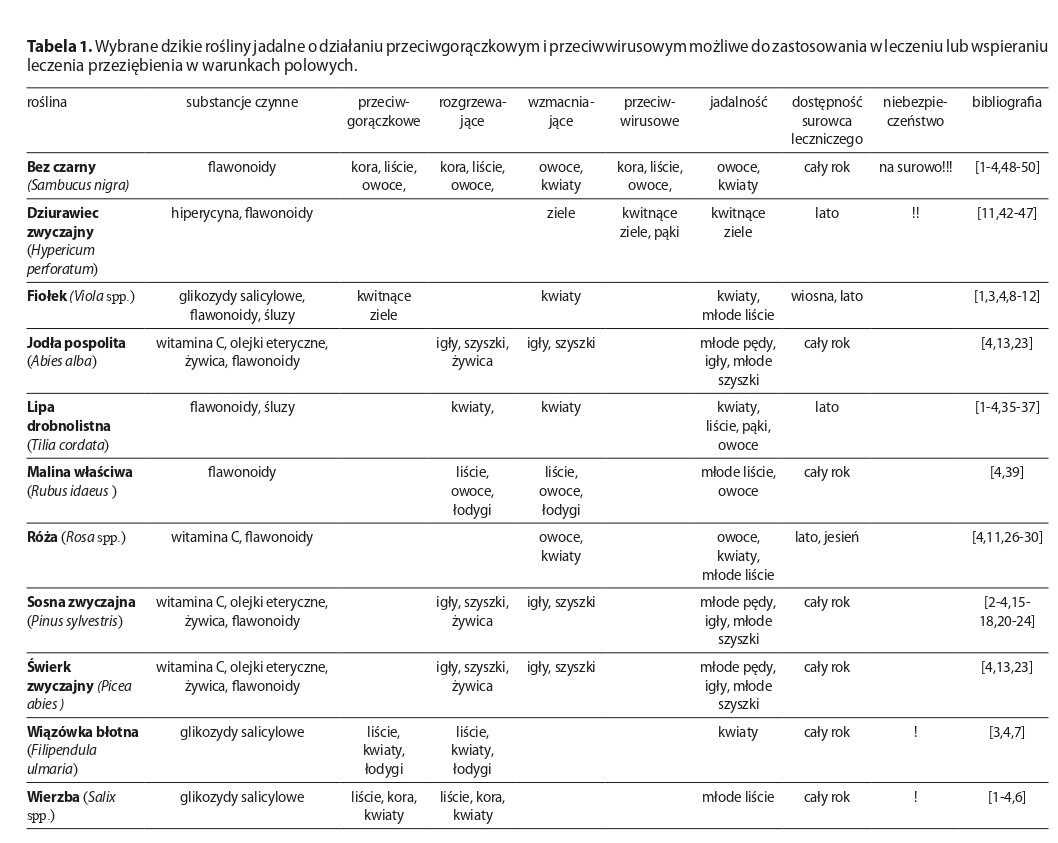
The effects of medicinal plants originate from the presence of flavonoids, saponins, tannins, and alkaloids, which can influence inflammatory processes, tissue health, or inhibit infections. Plants high in salicin (willow, meadowsweet, violet), plants rich in vitamin C (pine family, rose), and plants containing flavonoids (linden, raspberry, St. John‘s wort, elderberry) are presented. Harvest times, methods of processing them for food and medicinal purposes, safety precautions, and additional characteristics of these plants were described.
Summary:
Using wild plants as a food source increases the chances of survival in crisis situations, and taking into account their medicinal potential may prove very useful in field conditions and the lack of pharmaceutical supplies.
The aim of the study is to present a selection of wild plants growing in the temperate climate of the Northern Hemisphere that can be foraged as food, but also exhibit antipyretic and antiviral properties. Edible plants that can be used for medicinal purposes in field conditions were described, with an emphasis on plants that provide raw materials available year-round, or for most of the growing season.
Review methods:
The plants were selected through an analysis of textbooks on pharmacognosy, herbalism, and wild edible plants. A search of the PubMed and Google Scholar databases was subsequently conducted, using the Latin names of the selected plants and the terms ‘antipyretic’ and ‘antiviral’ as keywords. Publications from 2020–2025 were primarily considered. Articles were selected individually, initially by the content of abstracts and then by the full texts. Ultimately, 50 references indicating the potential use of selected plants in the treatment of fever and viral upper respiratory tract infections were presented.
Brief description of the state of knowledge:
The effects of medicinal plants originate from the presence of flavonoids, saponins, tannins, and alkaloids, which can influence inflammatory processes, tissue health, or inhibit infections. Plants high in salicin (willow, meadowsweet, violet), plants rich in vitamin C (pine family, rose), and plants containing flavonoids (linden, raspberry, St. John‘s wort, elderberry) are presented. Harvest times, methods of processing them for food and medicinal purposes, safety precautions, and additional characteristics of these plants were described.
Summary:
Using wild plants as a food source increases the chances of survival in crisis situations, and taking into account their medicinal potential may prove very useful in field conditions and the lack of pharmaceutical supplies.
REFERENCES (9)
1.
Kohlmunzer S. Farmakognozja. Wydawnictwo Lekarskie PZWL; 2020. ISBN: 9788320046519.
2.
Kaczmarczyk-Sedlak I, Ciołkowski A. Zioła w medycynie. Choroby układu oddechowego. Wydawnictwo Lekarskie PZWL; 2017. ISBN: 978-83-200-5475-0.
3.
Ożarowski A, Jaroniewski W. Rośliny lecznicze i ich praktyczne zastosowanie. Instytut Wydawniczy Związków Zawodowych; 1987. ISBN 83-20204720.
4.
Łuczaj Ł. Dzikie rośliny jadalne Polski: przewodnik survivalowy. Chemigrafia, Krosno; 2004. ISBN 83-904633-5-0.
5.
Saleem M, Fariduddin Q, Castroverde CDM. Salicylic acid: A key regulator of redox signalling and plant immunity. Plant Physiol Biochem. 2021;168:381–397. doi:10.1016/j.plaphy.2021.10.011.
6.
Tawfeek N, Mahmoud MF, Hamdan DI, et al. Phytochemistry, Pharmacology and Medicinal Uses of Plants of the Genus Salix: An Updated Review. Front Pharmacol. 2021;12:593856. doi:10.3389/fphar.2021.593856.
7.
Pannakal ST, Eilstein J, Hubert J, et al. Rapid Chemical Profiling of Filipendula ulmaria Using CPC Fractionation, 2-D Mapping of 13C NMR Data, and High-Resolution LC-MS. Molecules. 2023;28(17):6349. doi:10.3390/molecules28176349.
8.
Feyzabadi Z, Ghorbani F, Vazani Y, et al. A Critical Review on Phytochemistry, Pharmacology of Viola odorata L. and Related Multipotential Products in Traditional Persian Medicine. Phytother Res. 2017;31(11):1669–1675. doi:10.1002/ptr.5909.
9.
Tafazoli V, Shahriari M, Heydari M, et al. The Effect of Viola Odorata L. Oil for Fever in Children: A Randomized Triple-blinded Placebo-controlled Clinical Trial. Curr Drug Discov Technol. 2020;17(5):696–703. doi:10.2174/1570163816666190620142256.
| eISSN: | 2084-4905 |
| ISSN: | 2083-4543 |

We process personal data collected when visiting the website. The function of obtaining information about users and their behavior is carried out by voluntarily entered information in forms and saving cookies in end devices. Data, including cookies, are used to provide services, improve the user experience and to analyze the traffic in accordance with the Privacy policy. Data are also collected and processed by Google Analytics tool (more).
You can change cookies settings in your browser. Restricted use of cookies in the browser configuration may affect some functionalities of the website.
You can change cookies settings in your browser. Restricted use of cookies in the browser configuration may affect some functionalities of the website.