
REVIEW PAPER
The impact of fish and fish oil consumption on lipid disorders
1
Student Scientific Association of Lifestyle Medicine; The Student Scientific Society of Poznan University of Medical Sciences, Poznań University of Medical Sciences, Poland, Polska
2
Szpital Średzki Serca Jezusowego
3
Studenckie Koło Naukowe Medycyny Stylu Życia; Studenckie Towarzystwo Naukowe Uniwersytetu Medycznego im. K. Marcinkowskiego w Poznaniu; Uniwersytet Medyczny im. K. Marcinkowskiego w Poznaniu
4
Uniwersytecki Szpital Kliniczny w Poznaniu
5
Oddział Dzienny Psychiatryczny Rehabilitacyjny dla Dzieci i Młodzieży, Centrum Zdrowia Psychicznego dla Dzieci i Młodzieży, Poznań
6
Katedra i Zakład Medycyny Rodzinnej; Uniwersytet Medyczny im. Karola Marcinkowskiego w Poznaniu
Corresponding author
Damian Skrypnik
Katedra i Zakład Medycyny Rodzinnej, Uniwersytet Medyczny im. Karola Marcinkowskiego w Poznaniu, Poznań, Polska
Katedra i Zakład Medycyny Rodzinnej, Uniwersytet Medyczny im. Karola Marcinkowskiego w Poznaniu, Poznań, Polska
Med Og Nauk Zdr. 2026;32(3):184-191

KEYWORDS
TOPICS
ABSTRACT
Introduction and objective:
This study presents an analysis and summary of current research on the effects of consuming various types of fish and fish oils by healthy individuals and patients with cardiovascular diseases on lipid disorders, which constitute a significant risk factor for the development of cardiovascular diseases.
Review methods:
Researchers utilized articles published in the PubMed and Google Scholar databases. The following key words were used: ‘fish, hypertriglyceridemia, hypercholesterolemia, dyslipidaemia’. Articles published before 1 January 2014, nonoriginal studies, and those with a sample size of less than six participants were excluded. The articles were initially selected based on the content of their abstracts, and subsequently on full texts. Ultimately, 17 articles were presented.
Brief description of the state of knowledge:
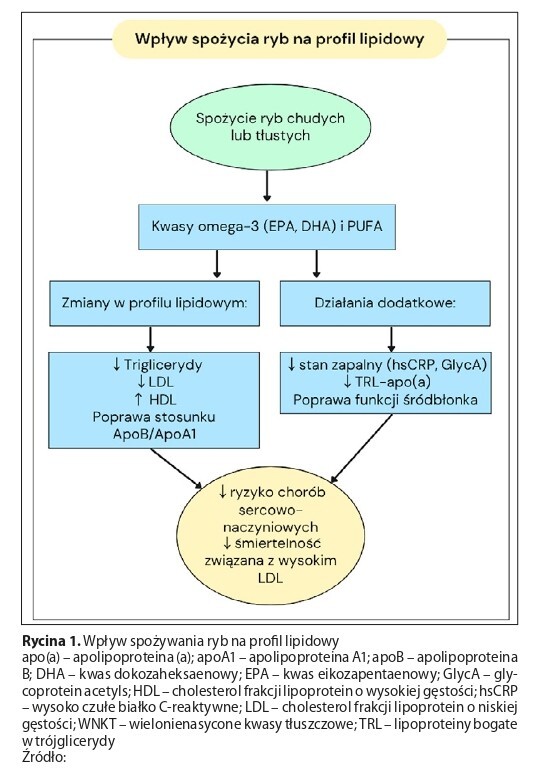
Lowering LDL cholesterol levels is one of the key therapeutic goals for reducing mortality from cardiovascular diseases. Studies show beneficial effects of fish and fish oil consumption on lipid profile. Polyunsaturated fatty acids, especially omega-3, play an important role. Regular consumption of fatty fish, besides reducing cardiovascular risk, modulates inflammation, has antithrombotic effects, supports central nervous system development, and improves cognitive functions. Consumption of lean fish positively affects lipid metabolism, including increasing HDL cholesterol. Fish oils recommended for patients with hypertriglyceridemia, inhibit progression of coronary artery disease. Benefits of supplementation have also been observed in patients with type 2 diabetes, familial hypercholesterolemia and lipid disorders
Summary:
The results of this review confirm that regular consumption of an adequate amount of fish (2–4 servings per week) and omega-3 supplementation constitute an effective strategy in the prevention and treatment of dyslipidaemia
This study presents an analysis and summary of current research on the effects of consuming various types of fish and fish oils by healthy individuals and patients with cardiovascular diseases on lipid disorders, which constitute a significant risk factor for the development of cardiovascular diseases.
Review methods:
Researchers utilized articles published in the PubMed and Google Scholar databases. The following key words were used: ‘fish, hypertriglyceridemia, hypercholesterolemia, dyslipidaemia’. Articles published before 1 January 2014, nonoriginal studies, and those with a sample size of less than six participants were excluded. The articles were initially selected based on the content of their abstracts, and subsequently on full texts. Ultimately, 17 articles were presented.
Brief description of the state of knowledge:
Lowering LDL cholesterol levels is one of the key therapeutic goals for reducing mortality from cardiovascular diseases. Studies show beneficial effects of fish and fish oil consumption on lipid profile. Polyunsaturated fatty acids, especially omega-3, play an important role. Regular consumption of fatty fish, besides reducing cardiovascular risk, modulates inflammation, has antithrombotic effects, supports central nervous system development, and improves cognitive functions. Consumption of lean fish positively affects lipid metabolism, including increasing HDL cholesterol. Fish oils recommended for patients with hypertriglyceridemia, inhibit progression of coronary artery disease. Benefits of supplementation have also been observed in patients with type 2 diabetes, familial hypercholesterolemia and lipid disorders
Summary:
The results of this review confirm that regular consumption of an adequate amount of fish (2–4 servings per week) and omega-3 supplementation constitute an effective strategy in the prevention and treatment of dyslipidaemia
PEER REVIEW INFORMATION
Article has been screened for originality
REFERENCES (38)
1.
Du H, Shi Q, Song P, et al. Global Burden Attributable to High Low-Density Lipoprotein-Cholesterol From 1990 to 2019. Front. Cardiovasc. Med. 2022;9:903126.
2.
Pirillo A, Casula M, Olmastroni E, et al. Global epidemiology of dyslipidaemias. Nat Rev Cardiol. 2021;18(10):689–700.
3.
François Mach, Konstantinos C Koskinas, Jeanine E Roeters van Lennep, et al. Guidelines for the management of dyslipidaemias: Developed by the task force for the management of dyslipidaemias of the European Society of Cardiology (ESC) and the European Atherosclerosis Society (EAS). European Heart Journal. 2025;46(42):4359–4378.
4.
Prospective Studies Collaboration, Lewington S, Whitlock G, Clarke R, et al. Blood cholesterol and vascular mortality by age, sex, and blood pressure: a meta-analysis of individual data from 61 prospective studies with 55,000 vascular deaths. Lancet Lond Engl. 2007;370(9602):1829–1839.
5.
Luengo-Fernandez R, Walli-Attaei M, Gray A, et al. Economic burden of cardiovascular diseases in the European Union: a population-based cost study. Eur Heart J. 2023;44(45):4752–4767.
6.
Zdrojewski T, Solnica B, Cybulska B, et al. Częstość występowania zaburzeń lipidowych w Polsce. badanie NATPOL 2011. Pol Heart J. Kardiol Pol. 2016;74(3):213–223.
7.
Niklas A, Marcinkowska J, Kozela M, et al. Blood pressure and cholesterol control in patients with hypertension and hypercholesterolemia: the results from the Polish multicenter national health survey WOBASZ II. Pol Arch Intern Med. 2019;129(12):864–873.
8.
Pająk A, Wiercińska E, Polakowska M, et al. Rozpowszechnienie dyslipidemii u mężczyzn i kobiet w wieku 20–74 lat w Polsce. Wyniki programu WOBASZ. Pol Heart J Kardiologia Pol. 2005;63(IV):81529.
9.
Pająk A, Szafraniec K, Polak M, et al. Changes in the prevalence, treatment, and control of hypercholesterolemia and other dyslipidemias over 10 years in Poland: the WOBASZ study. Pol Arch Intern Med. 2016;126(9):642–652.
10.
Visseren FLJ, Mach F, Smulders YM, et al. 2021 ESC Guidelines on cardiovascular disease prevention in clinical practice: Developed by the Task Force for cardiovascular disease prevention in clinical practice with representatives of the European Society of Cardiology and 12 medical societies With the special contribution of the European Association of Preventive Cardiology (EAPC) Eur Heart J. 2021;42(34):3227–3337.
11.
Lichtenstein AH, Appel LJ, Vadiveloo M, et al. 2021 Dietary Guidance to Improve Cardiovascular Health: A Scientific Statement From the American Heart Association. Circulation. 2021;144(23):472–487.
12.
Lisiak E, Morytz-Balska E, Gus EM, et al. Polska w liczbach 2024. Główny Urząd Statystyczny, Departament Opracowań Statystycznych. Warszawa. https://stat.gov.pl/obszary-te... inne-opracowania-zbiorcze/polska-w-liczbach-2024,14,17.html (access:2025.01.22).
13.
Ricci H, Gaeta M, Franchi C, et al. Fish Intake in Relation to Fatal and Non-Fatal Cardiovascular Risk: A Systematic Review and Meta-Analysis of Cohort Studies. Nutrients. 2023;15(21):4539.
14.
Mohan D, Mente A, Dehghan, et al. Associations of Fish Consumption With Risk of Cardiovascular Disease and Mortality Among Individuals With or Without Vascular Disease From 58 Countries. JAMA Int Med, 2021;181(5):631–649.
15.
Backes J, Anzalone D, Hilleman D, et al. The clinical relevance of omega-3 fatty acids in the management of hypertriglyceridemia. Lipids Health Dis. 2016;15(1):118.
16.
Arca M, Borghi C, Pontremoli R, et al. Hypertriglyceridemia and omega-3 fatty acids: Their often overlooked role in cardiovascular disease prevention. Nutr Metab Cardiovasc Dis NMCD. 2018;28(3):197–205.
17.
Hustad KS, Rundblad A, Ottestad I, et al. Comprehensive lipid and metabolite profiling in healthy adults with low and high consumption of fatty fish: a cross-sectional study. Br J Nutr. 2021;125(9):1034–1042.
18.
Yang KY, Yong CS, Choi HD, et al. Diet and lipid-lowering drug use among people with dyslipidemia in Korea. Asia Pac J Clin Nutr.
20.
Kim SA, Lee J koo, Kang D, et al. Oily Fish Consumption and the Risk of Dyslipidemia in Korean Adults: A Prospective Cohort Study Based on the Health Examinees Gem (HEXA-G) Study. Nutrients. 2019;11(10):2506.
21.
Erkkilä AT, Schwab US, Lehto S, et al. Effect of fatty and lean fish in take on lipoprotein subclasses in subjects with coronary heart disease: a controlled trial. J Clin Lipidol. 2014;8(1):126–133.
22.
Raatz SK, Johnson LK, Rosenberger TA, et al. Twice weekly intake of farmed Atlantic salmon (Salmo salar) positively influences lipoprotein concentration and particle size in overweight men and women. Nutr Res. 2016;36(9):899–906.
23.
Manninen SM, Lankinen MA, de Mello VD, et al. Intake of Fatty Fish Alters the Size and the Concentration of Lipid Components of HDL Particles and Camelina Sativa Oil Decreases IDL Particle Concentration in Subjects with Impaired Glucose Metabolism. Mol Nutr Food Res. 2018;62(10):201701042.
24.
Lankinen M, Kolehmainen M, Jääskeläinen T, et al. Effects of whole grain, fish and bilberries on serum metabolic profile and lipid.
25.
transfer protein activities: a randomized trial (Sysdimet). PLOS One. 2014;9(2):0090352.
26.
Hagen IV, Helland A, Bratlie M, et al. High intake of fatty fish, but not of lean fish, affects serum concentrations of TAG and HDL-cholesterol in healthy, normal-weight adults: a randomised trial. Br J Nutr. 2016;116(4):648–657.
27.
Mohanty BP, Mahanty A, Ganguly S, et al. Nutritional composition of food fishes and their importance in providing food and nutritionalsecurity. Food Chem. 2019;293:561–570.
28.
Zibaeenezhad MJ, Ghavipisheh M, Attar A, et al. Comparison of the effect of omega-3 supplements and fresh fish on lipid profile: a randomized, open-labeled trial. Nutr Diabetes. 2017;7(12):1.
29.
Tørris C, Molin M, Cvancarova MS. Lean fish consumption is associated with lower risk of metabolic syndrome: a Norwegian cross sectional study. BMC Public Health. 2016;16(1):347.
30.
Leaf DA, Hatcher L. The Effect of Lean Fish Consumption on Triglyceride Levels. Phys Sportsmed. 2009; 37(1):37–43.
31.
Blom WAM, Koppenol WP, Hiemstra H, et al. A low-fat spread with added plant sterols and fish omega-3 fatty acids lowers serum triglyceride and LDL-cholesterol concentrations in individuals with modest hypercholesterolaemia and hypertriglyceridaemia. Eur J Nutr.2019;58(4):1615–1624.
32.
Liu H, Wang F, Liu X, et al. Effects of marine-derived and plant-derived omega-3 polyunsaturated fatty acids on erythrocyte fatty acid composition in type 2 diabetic patients. Lipids Health Dis. 2022;21:20.
33.
Saraswathi V, Heineman R, Alnouti Y, et al. A combination of Omega-3 PUFAs and COX inhibitors: A novel strategy to manage obesity-linked dyslipidemia and adipose tissue inflammation. J Diabetes Complications. 2020;34(2):107494.
34.
Austin G, Ferguson JJ, Thota RN, et al. Postprandial lipaemia following consumption of a meal enriched with medium chain saturated and/or long chain omega-3 polyunsaturated fatty acids. A randomised cross-over study. Clin Nutr Edinb Scotl. 2021;40(2):420–427.
35.
Ferchaud-Roucher V, Zair Y, Aguesse A, et al. Omega 3 Improves Both apoB100-containing Lipoprotein Turnover and their Sphin-golipid Profile in Hypertriglyceridemia. J Clin Endocrinol Metab. 2020;105(10):dgaa459.
36.
Picklo M, Vallée Marcotte B, Bukowski M, et al. Identification of Phenotypic Lipidomic Signatures in Response to Long Chain n-3 Polyun-saturated Fatty Acid Supplementation in Humans. J Am Heart Assoc Cardiovasc Cerebrovasc Dis. 2021;10(3):e018126.
37.
Ying Q, Croyal M, Chan DC, et al. Effect of Omega-3 Fatty Acid Supplementation on the Postprandial Metabolism of Apolipoprotein(a) in Familial Hypercholesterolemia. J Atheroscler Thromb. 2023;30(3):274–286.
38.
Chan DC, Pang J, Barrett PHR, et al. ω-3 Fatty Acid Ethyl Esters Diminish Postprandial Lipemia in Familial Hypercholesterolemia. J Clin Endocrinol Metab. październik 2016;101(10): 3732–2739.
| eISSN: | 2084-4905 |
| ISSN: | 2083-4543 |

We process personal data collected when visiting the website. The function of obtaining information about users and their behavior is carried out by voluntarily entered information in forms and saving cookies in end devices. Data, including cookies, are used to provide services, improve the user experience and to analyze the traffic in accordance with the Privacy policy. Data are also collected and processed by Google Analytics tool (more).
You can change cookies settings in your browser. Restricted use of cookies in the browser configuration may affect some functionalities of the website.
You can change cookies settings in your browser. Restricted use of cookies in the browser configuration may affect some functionalities of the website.