
CASE REPORT
Sudden cardiac arrest due to ventricular fibrillation as the first manifestation of acute coronary syndrome – Importance of rapid intervention and modern assistive techniques
1
Student Scientific Circle at 2nd Department of Cardiology, Faculty of Medical Sciences in Zabrze, Medical University of Silesia, Katowice, Poland, Polska
2
Department of Cardiac, Vascular and Endovascular Surgery and Transplantology, Faculty of Medical Sciences in Zabrze, Medical University of Silesia, Katowice, Poland, Polska
3
2nd Department of Cardiology, Faculty of Medical Sciences in Zabrze, Medical University of Silesia, Katowice, Poland., Polska
Corresponding author
Damian Kawecki
II Katedra i Oddział Kliniczny Kardiologii, Wydział Nauk Medycznych w Zabrzu, Śląski Uniwersytet Medyczny w Katowicach, Polska, Skłodowskiej-Curie 10, 41-800, Zabrze, Polska
II Katedra i Oddział Kliniczny Kardiologii, Wydział Nauk Medycznych w Zabrzu, Śląski Uniwersytet Medyczny w Katowicach, Polska, Skłodowskiej-Curie 10, 41-800, Zabrze, Polska
Med Og Nauk Zdr. 2026;32(1):82-85

KEYWORDS
TOPICS
ABSTRACT
Introduction:
Sudden cardiac arrest (SCA) is one of the most severe manifestations of acute coronary syndrome (ACS). The prognosis critically depends on rapid diagnosis and immediate implementation of life-saving interventions by both bystanders and medical personnel.
Case report:
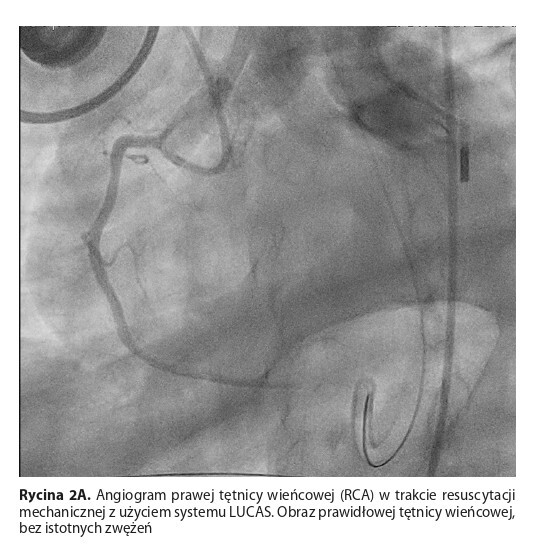
The case of a 65-year-old man is presented who experienced anginal pain for the first time in his life during daily activities. On his way to the hospital, shortly after entering the building, he suffered SCA due to ventricular fibrillation. Thanks to the immediate intervention of the hospital staff, the use of the LUCAS mechanical chest compression system, and rapid transport to the catheterization lab it was possible to restore sinus rhythm after multiple defibrillations and successful angioplasty of an occluded left anterior descending artery (LAD). Despite the implementation of advanced treatments, including intra-aortic balloon pump (IABP), continuous renal replacement therapy (CRRT), and extracorporeal membrane oxygenation (ECMO), the patient died due to progressing multi-organ failure.
Conclusions:
Effective and immediate cardiopulmonary resuscitation (CPR), rapid reperfusion, and the use of modern support techniques can lead to the restoration of circulation and consciousness, but do not always guarantee survival. This case highlights the importance of early intervention, good coordination of emergency teams, and public education on diagnosing ACS symptoms.
Sudden cardiac arrest (SCA) is one of the most severe manifestations of acute coronary syndrome (ACS). The prognosis critically depends on rapid diagnosis and immediate implementation of life-saving interventions by both bystanders and medical personnel.
Case report:
The case of a 65-year-old man is presented who experienced anginal pain for the first time in his life during daily activities. On his way to the hospital, shortly after entering the building, he suffered SCA due to ventricular fibrillation. Thanks to the immediate intervention of the hospital staff, the use of the LUCAS mechanical chest compression system, and rapid transport to the catheterization lab it was possible to restore sinus rhythm after multiple defibrillations and successful angioplasty of an occluded left anterior descending artery (LAD). Despite the implementation of advanced treatments, including intra-aortic balloon pump (IABP), continuous renal replacement therapy (CRRT), and extracorporeal membrane oxygenation (ECMO), the patient died due to progressing multi-organ failure.
Conclusions:
Effective and immediate cardiopulmonary resuscitation (CPR), rapid reperfusion, and the use of modern support techniques can lead to the restoration of circulation and consciousness, but do not always guarantee survival. This case highlights the importance of early intervention, good coordination of emergency teams, and public education on diagnosing ACS symptoms.
REFERENCES (14)
1.
Ujvárosy D, Földesi A, Zima E et al. Mechanical chest compression device use during transport and primary PCI enables ongoing resuscitation—case report. Front Cardiovasc Med. 2021;8:614493.
2.
Soar J, Böttiger BW, Carli P et al. European Resuscitation Council Guidelines 2021: Adult advanced life support. Resuscitation. 2021;161:115–151.
3.
Ozaki Y, Bueno H, Eagle KA et al. 2023 ESC Guidelines for the management of acute coronary syndromes. Eur Heart J. 2024;45(5):394–456.
4.
Min C, Ahn KO, Kim WY et al. Mechanical chest compression device use and neurologic outcomes after out-of-hospital cardiac arrest. Clin Exp Emerg Med. 2022;9(3):207–215.
5.
Nolan JP, Sandroni C, Böttiger BW et al. European Resuscitation Council and European Society of Intensive Care Medicine Guidelines 2021: Post-resuscitation care. Intensive Care Med. 2021;47(4):369–421.
6.
Kiguchi T, Okubo M, Nishiyama C et al. Outcomes of out-of-hospital cardiac arrest in Europe and Japan: A systematic review. Resuscitation. 2022;175:45–54.
7.
Andersen LW, Holmberg MJ, Berg KM et al. In-hospital cardiac arrest: A review. JAMA. 2019;321(12):1200–1210.
8.
El-Menyar A, Naduvilekandy M, Rizoli S et al. Mechanical versus manual cardiopulmonary resuscitation (CPR): an umbrella review. Crit Care. 2024;28(1):259.
9.
Mistraletti G, Giani M, Ristagno G et al. Mechanical chest compressions as a bridge to extracorporeal life support in refractory cardiac arrest. Resuscitation. 2023;185:109720.
10.
Pozzi M, Mongardon N, Deye N et al. Venoarterial ECMO for refractory cardiac arrest: clinical outcomes and prognostic factors. Crit Care. 2022;26(1):36.
11.
Kapur NK, Basir MB, Schreiber T et al. Mechanical circulatory support devices for acute right and left ventricular failure. Circulation. 2022;145(9):676–694.
12.
Lorusso R, Belohlavek J, Brodie D et al. Extracorporeal life support in refractory cardiac arrest (ECPR). Intensive Care Med. 2023;49(1):89–102.
13.
Ibanez B, James S, Agewall S et al. 2025 ESC Guidelines for the management of acute coronary syndromes. Eur Heart J. 2025;46(2):210–278.
14.
Matsushima Y, Sekine T, Shinzawa M et al. Association of mechanical chest compressions with intrathoracic bleeding complications during extracorporeal cardiopulmonary resuscitation. Resusc Plus. 2025;16:100350.
| eISSN: | 2084-4905 |
| ISSN: | 2083-4543 |

We process personal data collected when visiting the website. The function of obtaining information about users and their behavior is carried out by voluntarily entered information in forms and saving cookies in end devices. Data, including cookies, are used to provide services, improve the user experience and to analyze the traffic in accordance with the Privacy policy. Data are also collected and processed by Google Analytics tool (more).
You can change cookies settings in your browser. Restricted use of cookies in the browser configuration may affect some functionalities of the website.
You can change cookies settings in your browser. Restricted use of cookies in the browser configuration may affect some functionalities of the website.